Generalization and Specialization in DBMS
Imagine designing the database for a learning platform like CS Engineering Gyan. The platform has different types of registered users, students who watch tutorials and track their progress, and instructors who create courses and manage content. Both types of users share certain common information, such as a name and an email address, but each also has attributes that are entirely specific to their role.
Designing this kind of database naively, by creating one giant table with every possible attribute for every type of user, would quickly become messy and inefficient, filled with unused, empty columns depending on which type of user a particular row represents. This is exactly the kind of design challenge that Generalization and Specialization are meant to solve.
In this tutorial, you will learn what Generalization and Specialization mean in the context of ER modeling, how they relate to inheritance concepts found in object-oriented programming, the constraints that govern how they are applied, and how Aggregation complements these concepts when representing complex relationships.
Why Do We Need Generalization and Specialization?
Real-world entities often do not fit neatly into a single, uniform category. Some entities share common characteristics with others, while also possessing unique attributes and behaviors of their own. Traditional ER modeling, using only basic entities and relationships, struggles to represent this kind of hierarchical structure cleanly.
Generalization and Specialization introduce a way to model these hierarchical relationships directly within the ER model, allowing designers to represent shared and distinct characteristics between related entity types in a structured, organized manner, much like the relationship between a general "User" and more specific types like "Student" and "Instructor" on a platform like CS Engineering Gyan.
What is Specialization in DBMS?
Specialization is a top-down approach in ER modeling where a single, general entity is divided into two or more specialized sub-entities, based on distinguishing characteristics. Each sub-entity inherits the attributes of the general entity, while also having its own additional, specific attributes.
Example
Consider a general entity called User on the CS Engineering Gyan platform, containing common attributes like UserID, Name, and Email. Through specialization, this User entity can be divided into two specific sub-entities: Student and Instructor.
| Entity | Attributes |
|---|---|
| User (General Entity) | UserID, Name, Email |
| Student (Specialized Entity) | UserID, Name, Email, EnrollmentDate, CoursesEnrolled |
| Instructor (Specialized Entity) | UserID, Name, Email, Specialization, CoursesCreated |
Notice how both Student and Instructor inherit the shared attributes from the general User entity, while also having their own attributes that are only relevant to their specific role on the platform.
What is Generalization in DBMS?
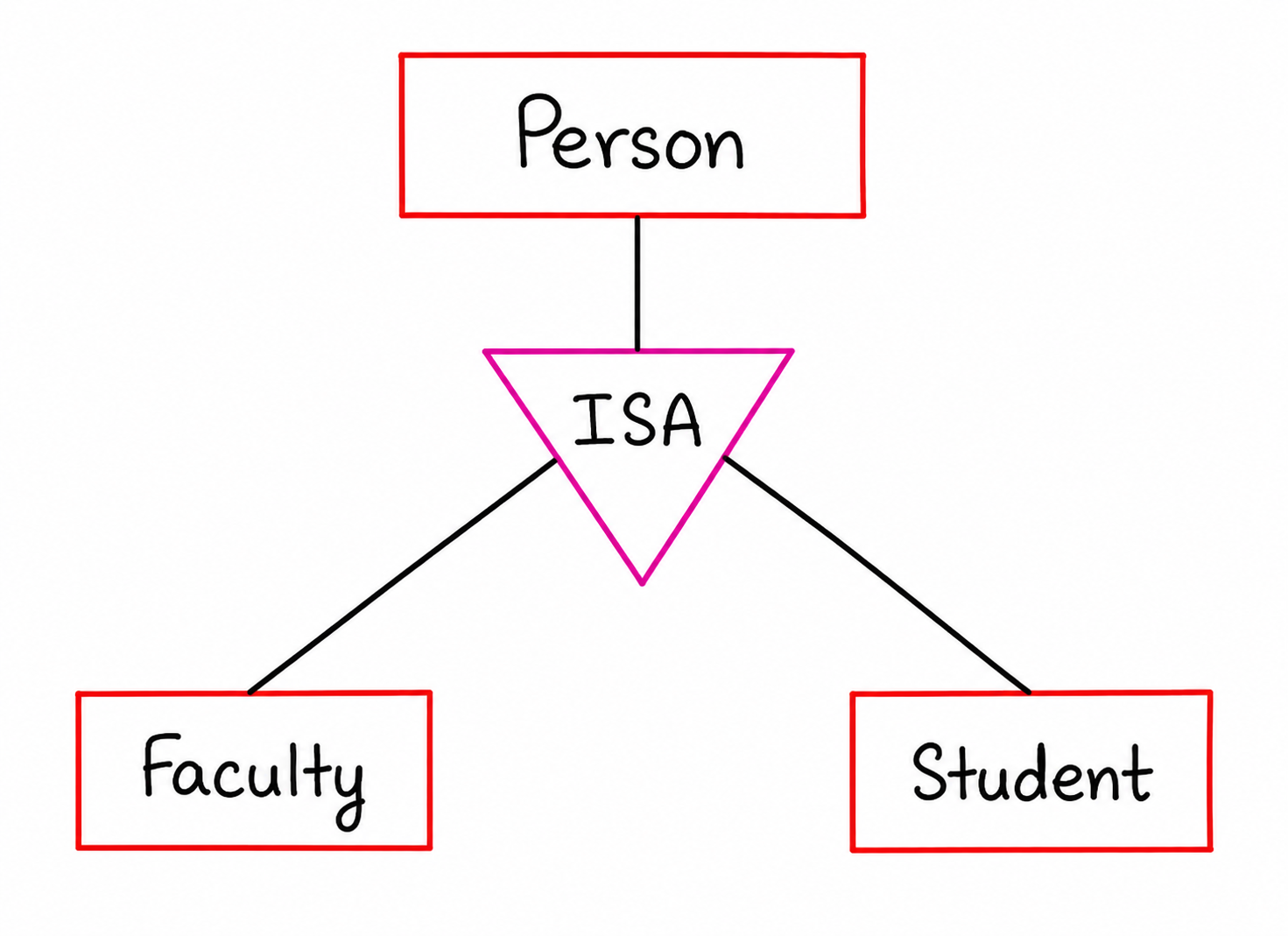
Generalization is essentially the reverse process of specialization. Instead of starting with a general entity and dividing it into specific types, generalization is a bottom-up approach where two or more entities that share common attributes are combined into a single, more general entity.
Example
Suppose the CS Engineering Gyan platform initially designed separate entities for Student and Instructor independently, without realizing they shared common attributes. Through generalization, these two entities can be combined into a single general User entity, containing the shared attributes, while the distinguishing attributes remain in their respective specialized entities.
| Before Generalization | After Generalization |
|---|---|
| Separate Student and Instructor entities with duplicated attributes like Name and Email. | A single User entity holding shared attributes, with Student and Instructor as specialized sub-entities. |
Generalization is particularly useful when a database has evolved over time, and designers later notice repeated, overlapping attributes across multiple entities that would benefit from being consolidated into a shared parent entity.
Generalization vs Specialization
| Generalization | Specialization |
|---|---|
| Follows a bottom-up approach, combining entities into a general one. | Follows a top-down approach, dividing a general entity into specific ones. |
| Starts with multiple specific entities and merges shared attributes. | Starts with one general entity and identifies distinguishing sub-types. |
| Useful when designers notice repeated attributes across separate entities. | Useful when a single entity naturally contains multiple distinct categories. |
Although they approach the problem from opposite directions, both generalization and specialization ultimately result in the same kind of hierarchical structure, where a general entity relates to one or more specialized sub-entities.
Inheritance in ER Modeling
The relationship between a general entity and its specialized sub-entities closely resembles the concept of inheritance found in object-oriented programming. Just as a subclass inherits properties from a parent class, a specialized entity inherits attributes from its general entity.
Example
On the CS Engineering Gyan platform, both Student and Instructor automatically inherit the UserID, Name, and Email attributes from the general User entity. Neither sub-entity needs to redefine these shared attributes independently, since they are inherited directly from the parent entity.
This inheritance-based structure keeps the database design consistent and avoids unnecessary duplication of shared information across multiple related entity types.
Constraints on Specialization
When applying specialization, database designers must consider certain constraints that determine how instances of the general entity relate to its specialized sub-entities. These constraints fall into two important categories: disjoint versus overlapping constraints, and total versus partial constraints.
Disjoint vs Overlapping Specialization
| Disjoint Specialization | Overlapping Specialization |
|---|---|
| An entity instance can belong to only one specialized sub-entity at a time. | An entity instance can belong to more than one specialized sub-entity simultaneously. |
| Example: A person is either a Student or an Instructor, not both. | Example: A person could be both a Student and an Instructor on the same platform. |
On a platform like CS Engineering Gyan, it is entirely possible for someone to be both a student learning new topics and an instructor creating tutorials for others, which would make this a case of overlapping specialization rather than disjoint specialization.
Total vs Partial Specialization
| Total Specialization | Partial Specialization |
|---|---|
| Every instance of the general entity must belong to at least one specialized sub-entity. | Some instances of the general entity may not belong to any specialized sub-entity. |
| Example: Every registered User must be either a Student or an Instructor. | Example: Some registered Users might exist as guests, without belonging to either specialized category. |
Choosing between total and partial specialization depends entirely on the actual business rules of the system being modeled. If the CS Engineering Gyan platform requires every registered user to have a defined role, total specialization would be the appropriate choice.
What is Aggregation in DBMS?
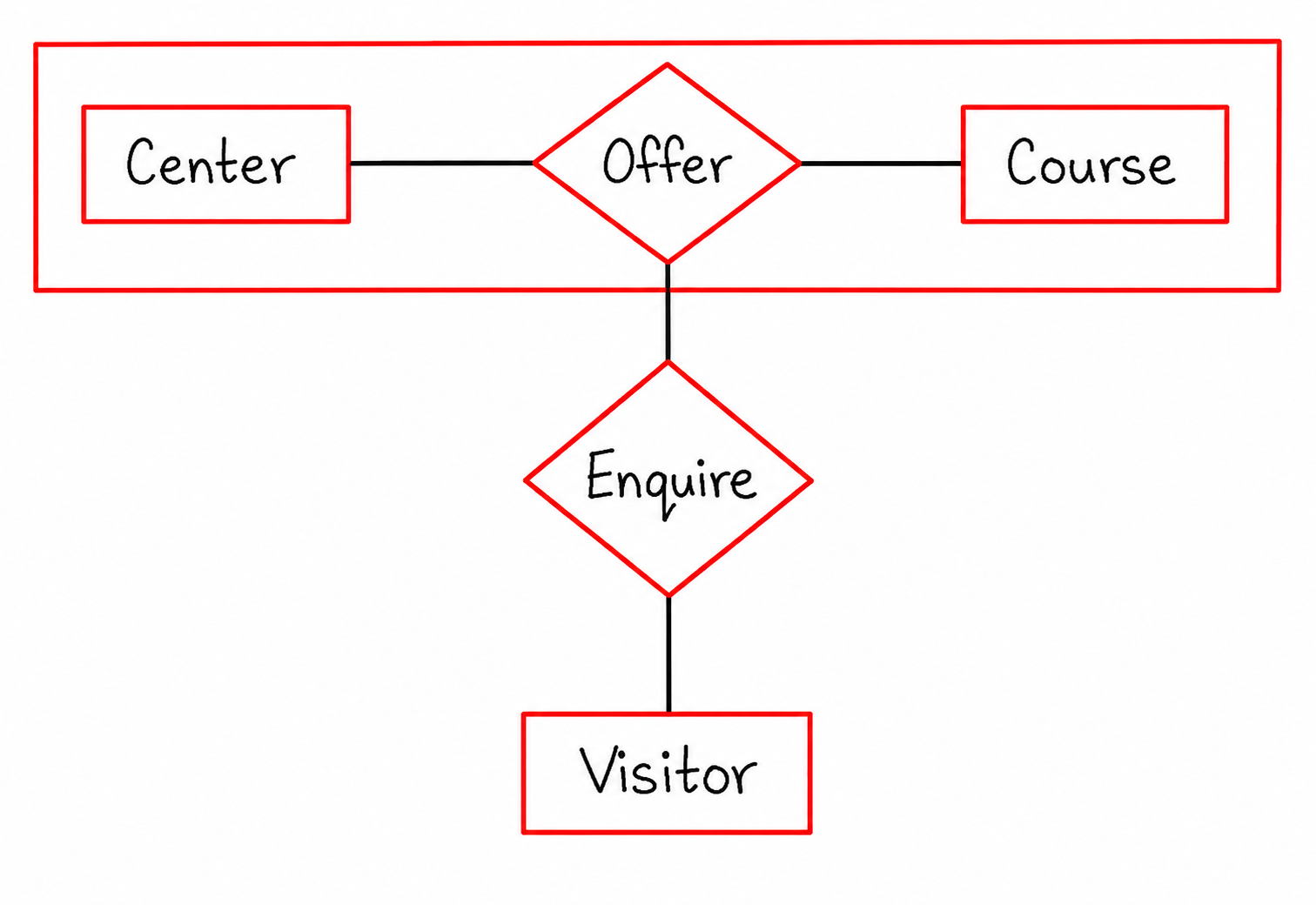
Aggregation is a concept closely related to generalization and specialization, used to represent a relationship where one relationship itself needs to be treated as a higher-level entity, allowing it to participate in another relationship.
Example
Consider a relationship on the CS Engineering Gyan platform where a Student enrolls in a Course, forming an "Enrollment" relationship. Now imagine that this entire Enrollment relationship needs to be associated with a Certificate entity, representing a certificate issued upon course completion. Since a relationship cannot directly participate in another relationship in standard ER modeling, aggregation treats the entire Enrollment relationship as a single abstract entity, allowing it to connect meaningfully with the Certificate entity.
| Without Aggregation | With Aggregation |
|---|---|
| No clean way to connect a relationship (Enrollment) to another entity (Certificate). | The Enrollment relationship is treated as a single unit, allowing a clear connection to Certificate. |
Aggregation essentially allows a group of entities and their relationship to be viewed as a single, higher-level entity, simplifying how complex, layered relationships are represented within the ER model.
Generalization and Specialization Together
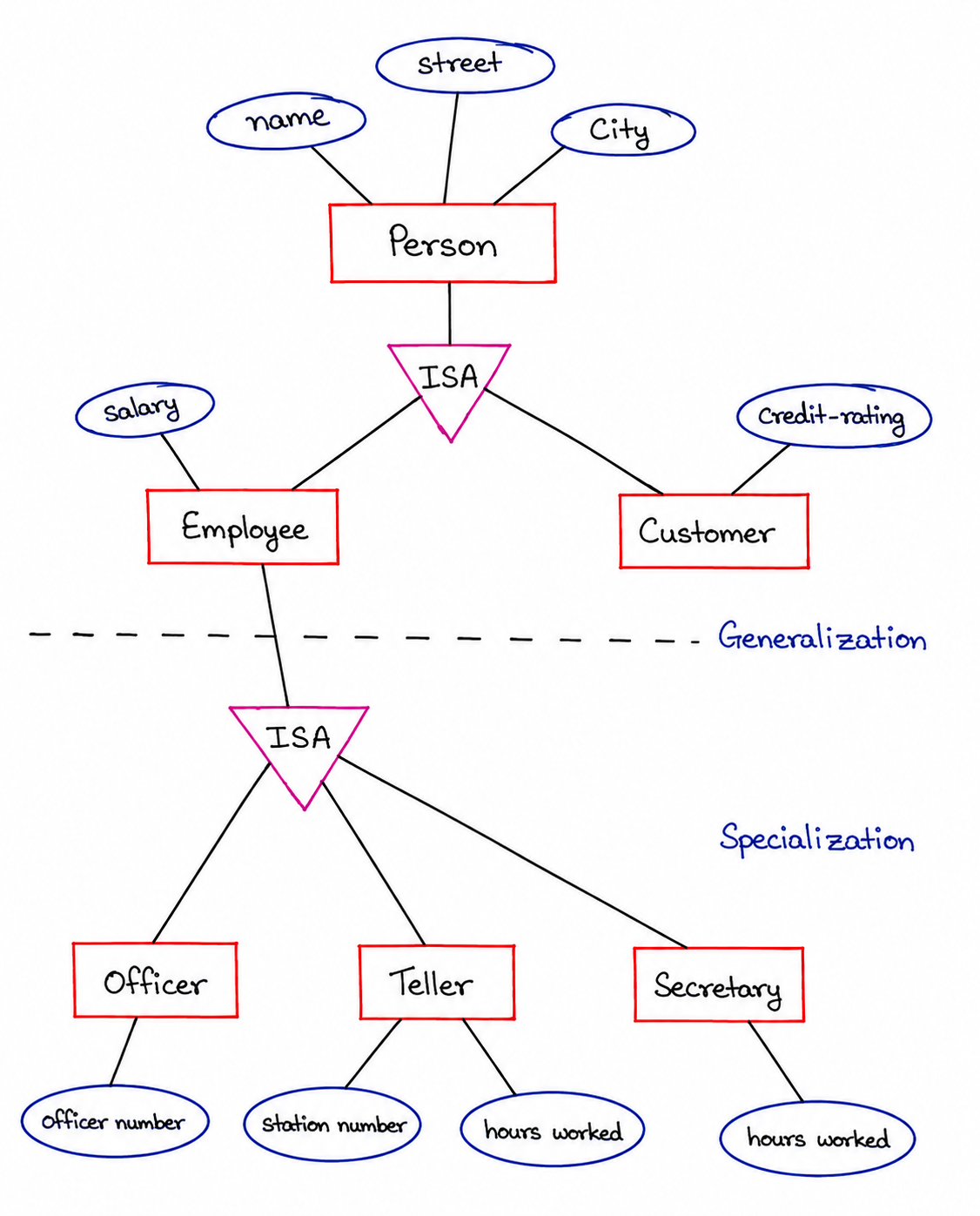
In many real-world database designs, generalization and specialization are applied together to build a well-structured hierarchy of entities. A general entity might be specialized into multiple categories, and those specialized categories might themselves be further specialized into even more specific sub-types.
Example
Extending the CS Engineering Gyan example, the Instructor entity could be further specialized into FullTimeInstructor and GuestInstructor, each carrying additional attributes relevant to their specific employment relationship with the platform, while still inheriting the shared attributes from both the Instructor and User entities above them.
| Level | Entity |
|---|---|
| General | User |
| Specialized | Instructor |
| Further Specialized | FullTimeInstructor, GuestInstructor |
This layered approach mirrors how multilevel inheritance works in object-oriented programming, allowing database designers to represent increasingly specific categories while still preserving shared attributes at each level of the hierarchy.
Advantages of Generalization and Specialization
- Reduces redundancy by keeping shared attributes defined only once, in the general entity.
- Makes the database structure more intuitive by mirroring real-world categorizations.
- Allows designers to model entities with both shared and unique characteristics cleanly.
- Provides flexibility to extend the database with new specialized categories in the future.
- Improves overall data organization, making the schema easier to understand and maintain.
Best Practices While Applying These Concepts
- Identify shared attributes carefully before deciding whether generalization or specialization fits the situation better.
- Clearly define whether a specialization should be disjoint or overlapping based on real business rules.
- Decide between total and partial specialization based on whether every general entity instance must belong to a sub-type.
- Use aggregation only when a relationship genuinely needs to participate in another relationship.
- Avoid creating unnecessary levels of specialization that do not reflect meaningful real-world distinctions.
Common Mistakes Beginners Make
| Mistake | Correct Practice |
|---|---|
| Confusing generalization with specialization, since they seem similar. | Remember that generalization combines entities upward, while specialization divides an entity downward. |
| Assuming all specializations are automatically disjoint. | Check whether an entity instance could genuinely belong to more than one sub-type before assuming disjointness. |
| Ignoring total versus partial constraints during database design. | Clearly define whether every general entity instance must belong to a specialized category. |
| Using aggregation unnecessarily for simple relationships. | Apply aggregation only when a relationship itself needs to connect to another entity. |
Frequently Asked Questions
-
What is specialization in DBMS?
Specialization is a top-down process where a general entity is divided into two or more specific sub-entities based on distinguishing characteristics. -
What is generalization in DBMS?
Generalization is a bottom-up process where multiple entities with shared attributes are combined into a single general entity. -
What is the main difference between generalization and specialization?
Generalization merges entities into a general one, while specialization divides a general entity into more specific sub-entities. -
What does disjoint specialization mean?
It means an entity instance can belong to only one specialized sub-entity at a time. -
What does overlapping specialization mean?
It means an entity instance can belong to more than one specialized sub-entity simultaneously. -
What is the difference between total and partial specialization?
Total specialization requires every general entity instance to belong to a sub-type, while partial specialization allows some instances to belong to none. -
What is aggregation in DBMS?
Aggregation treats a relationship as a higher-level entity, allowing it to participate in another relationship. -
How does specialization relate to inheritance in programming?
Specialized entities inherit attributes from their general entity, similar to how a subclass inherits properties from a parent class.
Summary
Generalization and Specialization extend the basic ER model, allowing database designers to represent hierarchical relationships between entities that share some attributes while also having their own distinct characteristics. Specialization works from the top down, dividing a general entity into specific categories, while generalization works from the bottom up, combining related entities into a shared parent.
Constraints such as disjoint versus overlapping, and total versus partial specialization, allow these concepts to accurately reflect real-world business rules, much like how a platform such as CS Engineering Gyan might need to represent overlapping roles between students and instructors. Aggregation further extends this flexibility, allowing complex relationships to be treated as higher-level entities when needed.
With a solid understanding of generalization, specialization, and aggregation, you are now ready to explore the Relational Model, which builds on these conceptual ideas to represent data using structured tables, tuples, and relations.