Data Types in C++
Data types in C++ define the type of data that a variable can store. They help the compiler understand how much memory to allocate and what kind of operations can be performed on the data.
Choosing the correct data type improves performance, memory usage, and program reliability.
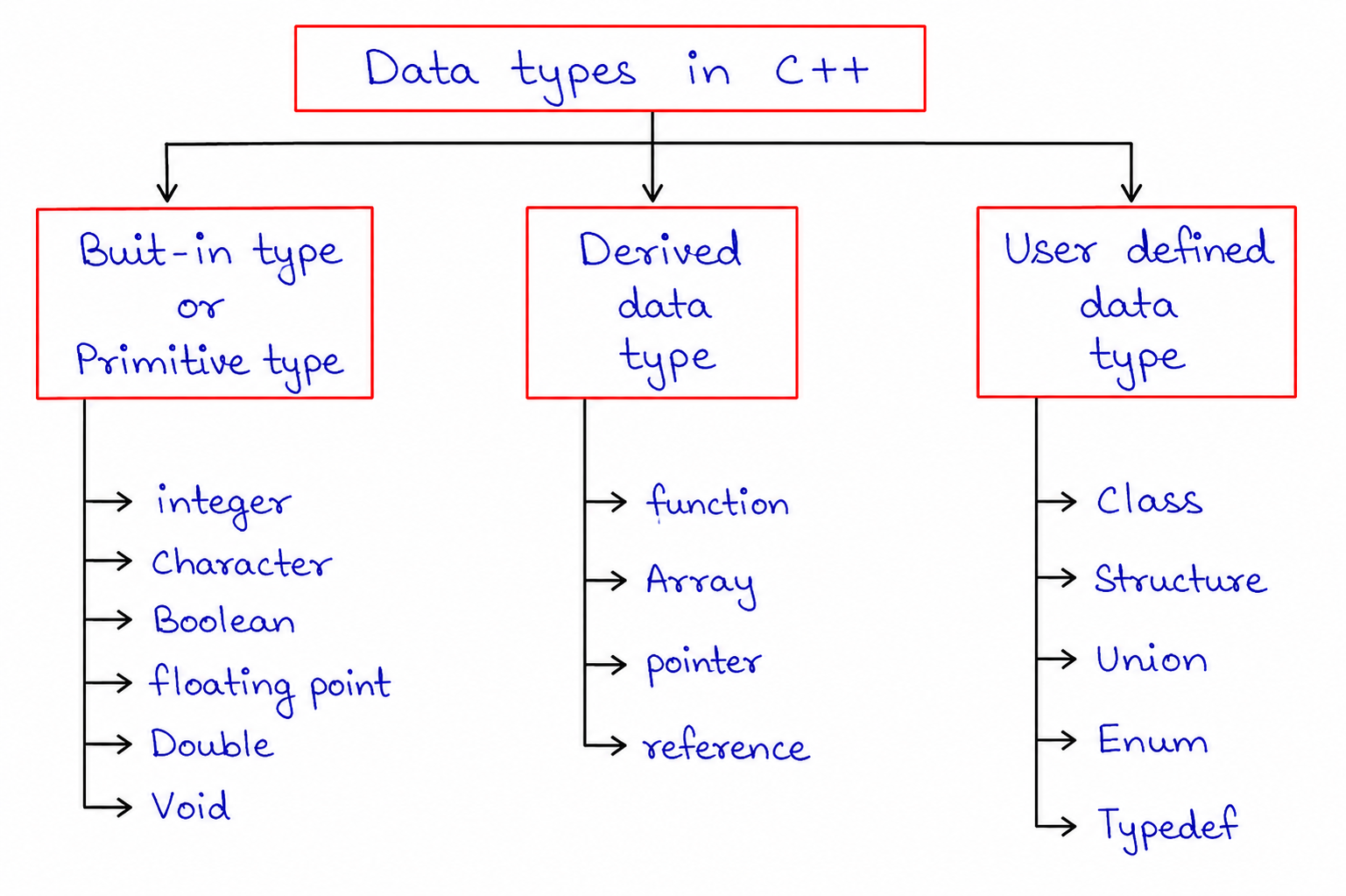
Types of Data Types in C++
Data types in C++ are broadly categorized into three main types:
- Built-in (Primitive) Data Types
- Derived Data Types
- User-Defined Data Types
1. Built-in (Primitive) Data Types in C++
In C++, primitive data types (also known as built-in data types) are the basic types provided by the language. These data types are used to store simple and fundamental values such as numbers, characters, and logical values.
They form the foundation of any C++ program because all variables are created using these data types. Understanding primitive types is essential before moving on to more advanced concepts.
What are Primitive Data Types?
Primitive data types directly store single values in memory. They are simple, efficient, and require less memory compared to complex data types. Each data type defines what kind of data a variable can hold and how much memory it will use.
Common Primitive Data Types
- int – Used to store whole numbers (e.g., 10, 25, -5)
- char – Used to store a single character (e.g., 'A', 'b')
- bool – Used to store logical values (true or false)
- float – Used to store decimal numbers with single precision (e.g., 3.14, 5.5)
- double – Used to store decimal numbers with higher precision
- void – Represents the absence of a value (commonly used in functions)
Memory and Usage
Each primitive data type uses a specific amount of memory, which may vary depending on the system and compiler. For example, int typically uses 4 bytes, while char usually uses 1 byte. Choosing the correct data type helps optimize memory usage and improves program performance.
Example Program
#include <iostream>
using namespace std;

int main()
{
    int age = 20;
    float marks = 85.5;
    char grade = 'A';
    bool passed = true;

    cout << "Age: " << age << endl;
    cout << "Marks: " << marks << endl;
    cout << "Grade: " << grade << endl;
    cout << "Passed: " << passed << endl;

    return 0;
}
Explanation of Example
In the above program:
ageis an integer variable storing a whole number.marksis a float variable storing a decimal value.gradestores a single character.passedstores a boolean value (true/false).
Key Points to Remember
- Primitive data types are the simplest form of data storage in C++.
- They are fast and efficient to use.
- Each type is designed for a specific kind of data.
- They serve as the building blocks for all advanced data structures.
2. Derived Data Types in C++
In C++, derived data types are created using the basic (primitive) data types. These types allow programmers to handle more complex data structures and relationships in an efficient way. They extend the functionality of primitive types by combining or referencing them.
Derived data types are very useful when working with collections of data, memory management, or reusable code blocks.
What are Derived Data Types?
Derived data types are formed by modifying or combining primitive data types. They provide flexibility and help in solving real-world programming problems more effectively.
Common Types of Derived Data Types
- Array: A collection of elements of the same data type stored in contiguous memory locations.
Example: storing marks of students. - Pointer: A variable that stores the memory address of another variable.
It is useful for dynamic memory allocation and efficient data handling. - Function: A block of reusable code designed to perform a specific task.
Functions help reduce code repetition and improve readability. - Reference: An alias (another name) for an existing variable.
It allows direct access to the original variable without copying data.
Example Program
#include <iostream>
using namespace std;

int main()
{
    int arr[3] = {10, 20, 30};   // Array
    int *ptr = &arr[0];          // Pointer

    cout << "First element: " << *ptr << endl;

    return 0;
}
Explanation of Example
arris an array that stores three integer values.ptris a pointer that holds the address of the first element of the array.*ptris used to access the value stored at that address (dereferencing).
Key Advantages
- They allow handling multiple values efficiently.
- They support advanced programming concepts like dynamic memory.
- They make programs more flexible and powerful.
- They reduce code repetition through reusable functions.
Important Points to Remember
- Derived data types are built from primitive data types.
- They are essential for writing structured and efficient programs.
- Understanding them is important for advanced topics like data structures.
3. User-Defined Data Types in C++
In C++, user-defined data types are created by programmers to represent complex data in a more organized and meaningful way. Unlike primitive or derived data types, these types allow you to design your own data structures based on program requirements.
They are especially useful when dealing with real-world problems where a single variable is not enough to represent complete information.
What are User-Defined Data Types?
User-defined data types are custom types built using existing data types. They allow grouping of different types of data under a single name, making the program more structured and easier to manage.
Common User-Defined Data Types
- Class: A blueprint for creating objects. It is a fundamental concept in object-oriented programming and allows data and functions to be combined.
- Structure (struct): Used to group variables of different data types under one name. It is similar to a class but simpler.
- Union: A special type where all members share the same memory location. It helps save memory when only one member is used at a time.
- Enum (Enumeration): Used to define a set of named integer constants, making code more readable.
- Typedef: Provides a new name (alias) for an existing data type, improving code clarity.
Example Using Structure
#include <iostream>
using namespace std;

struct Student
{
    string name;
    int age;
};

int main()
{
    Student s1;

    s1.name = "Rahul";
    s1.age = 21;

    cout << s1.name << " " << s1.age;

    return 0;
}
Explanation of Example
Studentis a structure that groupsnameandageinto one unit.s1is an object of typeStudent.- We assign values to its members using the dot (
.) operator.
Advantages of User-Defined Data Types
- They help organize complex data efficiently.
- They improve code readability and structure.
- They make programs easier to maintain and expand.
- They support object-oriented programming concepts.
Key Points to Remember
- User-defined types are created by programmers based on requirements.
- They combine multiple data elements into one unit.
- They are essential for building large and complex applications.
Difference Between Data Types
| Type | Description | Example |
|---|---|---|
| Primitive | Basic data types provided by C++ | int, float |
| Derived | Created from primitive types | array, pointer |
| User-Defined | Created by programmer | struct, class |
Importance of Data Types
- Efficient memory usage
- Improves program performance
- Ensures type safety
- Makes code easy to understand
Conclusion
Data types are a fundamental part of C++ programming. They define how data is stored and manipulated in a program. Understanding primitive, derived, and user-defined data types helps developers write efficient, structured, and error-free programs.