Tokens in C++
In C++, a program is made up of small building blocks known as tokens. These are the smallest individual units that the compiler understands while processing a program.
Every statement in a C++ program is formed using different types of tokens. Understanding tokens is essential because they form the foundation of programming syntax.
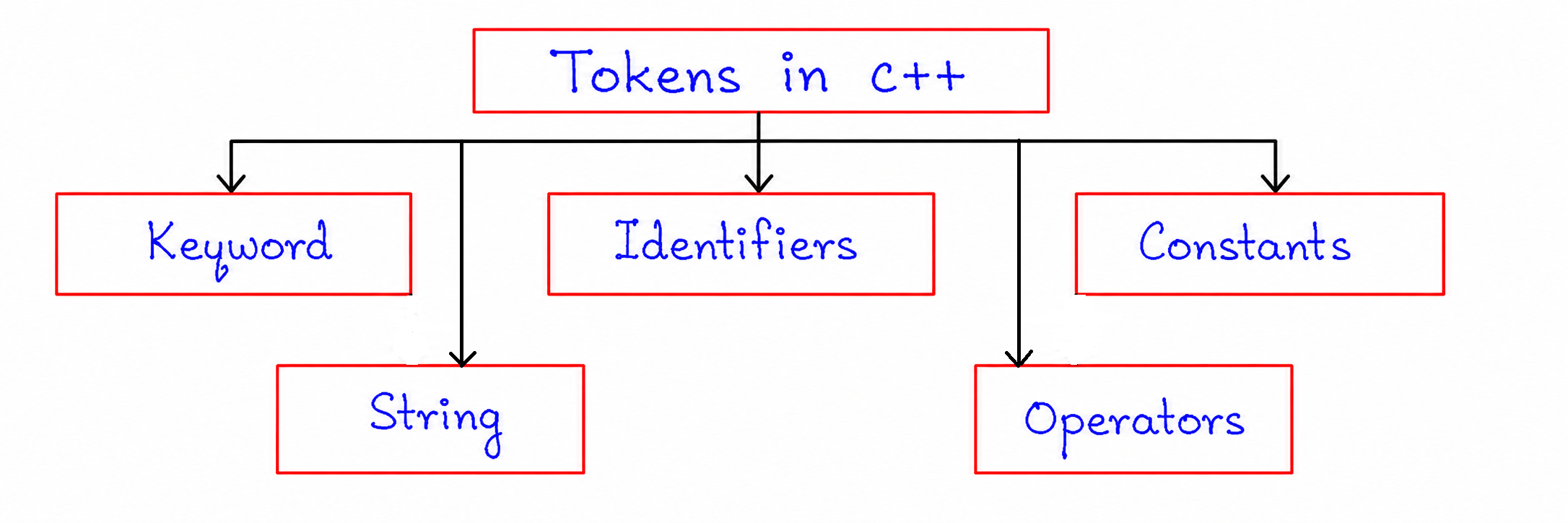
Types of Tokens in C++
C++ tokens are mainly divided into the following categories:
- Keywords
- Identifiers
- Constants
- Strings
- Operators
1. Keywords in C++
In C++, keywords are a set of reserved words that have predefined meanings assigned by the language. These words are an essential part of the syntax and are used by the compiler to understand the structure and behavior of a program.
Since keywords are already defined by the C++ language, they cannot be used as identifiers such as variable names, function names, or class names. Attempting to use a keyword for any other purpose will result in a compilation error.
🔹 Why Keywords Are Important?
- They define the structure of a C++ program.
- They help control the flow of execution (decision-making, looping).
- They specify data types and storage information.
- They make the program understandable to the compiler.
🔹 Commonly Used Keywords
Here are some frequently used keywords in C++:
int       float     double    char
if        else      switch    case
for       while     do        break
continue  return    void      const
class     public    private   protected
🔹 Categories of Keywords
C++ keywords can be grouped based on their functionality:
- Data Type Keywords: int, float, double, char, bool
- Control Flow Keywords: if, else, switch, case, for, while, do
- Jump Statements: break, continue, return
- Access Modifiers: public, private, protected
- Object-Oriented Keywords: class, this, new, delete
🔹 Example Program Using Keywords
#include <iostream>
using namespace std;

int main() {
    int number = 10;

    if (number > 0) {
        cout << "Positive number";
    } else {
        cout << "Negative number";
    }

    return 0;
}
In the above program, words like int, if, else, return are keywords. Each one has a fixed role that helps define how the program behaves.
🔹 Key Points to Remember
- Keywords are reserved and cannot be redefined.
- They are case-sensitive (e.g.,
intis different fromINT). - They form the backbone of every C++ program.
- Learning keywords is the first step toward mastering C++.
Overall, keywords act as the building blocks of C++ syntax, allowing programmers to write meaningful and structured programs efficiently.
2. Identifiers in C++
In C++, identifiers are the names assigned by the programmer to different elements of a program. These elements may include variables, functions, arrays, classes, objects, or any other user-defined items. Identifiers help make a program readable and meaningful by giving recognizable names to data and operations.
Instead of using memory addresses or complex representations, programmers use identifiers to refer to data easily. For example, a variable storing marks can be named marks, making the code more understandable.
🔹 Importance of Identifiers
- They improve code readability and clarity.
- They help in organizing large programs efficiently.
- They make debugging and maintenance easier.
- They allow programmers to represent real-world concepts in code.
🔹 Rules for Naming Identifiers
C++ follows strict rules for defining identifiers. These rules must be followed to avoid errors:
- An identifier must begin with a letter (A–Z or a–z) or an underscore (_).
- It cannot start with a number.
- It must not be a reserved keyword (such as int, float, if, etc.).
- It should not contain special characters like @, #, %, etc.
- Spaces are not allowed in identifiers.
- Identifiers are case-sensitive (e.g.,
valueandValueare different).
🔹 Examples of Valid Identifiers
int marks;
float totalScore;
double average_value;
char grade;
🔹 Examples of Invalid Identifiers
int 1marks;     // Starts with a number
float total-score;  // Contains special character (-)
int if;         // Keyword used as identifier
char student name;  // Contains space
🔹 Naming Conventions (Best Practices)
Although not enforced by the compiler, following good naming practices is highly recommended:
- Use meaningful names (e.g.,
totalMarksinstead oftm). - Follow consistent naming styles like camelCase or snake_case.
- Avoid overly long or confusing names.
- Use uppercase names for constants (e.g.,
MAX_SIZE).
🔹 Example Program Using Identifiers
#include <iostream>
using namespace std;

int main() {
    int marks = 85;
    float totalScore = 100.0;
    float percentage = (marks / totalScore) * 100;

    cout << "Percentage: " << percentage;

    return 0;
}
In this example, marks, totalScore, and percentage are identifiers that store values and make the program easy to understand.
🔹 Key Points to Remember
- Identifiers are user-defined names used in programs.
- They must follow specific rules defined by C++.
- They should always be meaningful and descriptive.
- Good naming improves code quality and maintainability.
In summary, identifiers act as labels for different components in a C++ program, making it easier for programmers to write, read, and manage code effectively.
3. Constants in C++
In C++, constants are values that remain fixed throughout the execution of a program. Unlike variables, once a constant is defined, its value cannot be modified or reassigned. Constants are useful when you need to store values that should stay unchanged, such as mathematical values, fixed limits, or configuration data.
🔹 Why Use Constants?
- They prevent accidental changes to important values.
- They improve program reliability and safety.
- They make code easier to understand and maintain.
- They help in writing cleaner and more organized programs.
🔹 Types of Constants
C++ supports different types of constants based on the kind of data they represent:
- Integer Constants: Whole numbers without decimal points (e.g., 10, 25, 100)
- Floating-Point Constants: Numbers with decimal values (e.g., 3.14, 0.5, 2.75)
- Character Constants: Single characters enclosed in single quotes (e.g., 'A', 'z')
- String Constants: A sequence of characters enclosed in double quotes (e.g., "Hello")
🔹 Defining Constants in C++
Constants are commonly defined using the const keyword. Once declared, their value cannot be changed later in the program.
const int x = 10;
const float PI = 3.14;
const char grade = 'A';
🔹 Example Program
#include <iostream>
using namespace std;

int main() {
    const float PI = 3.14;
    float radius = 5;

    float area = PI * radius * radius;

    cout << "Area of circle: " << area;

    return 0;
}
In this example, PI is a constant whose value remains unchanged throughout the program.
🔹 Important Points to Remember
- Constants cannot be modified after declaration.
- They must be initialized at the time of declaration.
- Using meaningful constant names improves readability.
- Constants are usually written in uppercase by convention (e.g.,
MAX_VALUE).
In summary, constants provide a safe way to store fixed values in a program, ensuring that important data remains unchanged and the code stays reliable.
4. Strings in C++
In C++, a string is a sequence of characters enclosed within double quotes (" "). Strings are mainly used to store and display text such as names, messages, and sentences in a program.
Each character in a string is stored in a continuous memory location, making it easy to handle and manipulate text data in programs.
🔹 Basic Examples of Strings
"Hello World"
"Welcome to C++"
"Programming is fun"
🔹 Using Strings in C++
Strings can be used directly in output statements or stored in variables using the string data type (from the standard library).
#include <iostream>
using namespace std;

int main() {
    cout << "Hello World";
    return 0;
}
🔹 Example with String Variable
#include <iostream>
#include <string>
using namespace std;

int main() {
    string message = "Welcome to C++";

    cout << message;

    return 0;
}
🔹 Important Features of Strings
- Strings are enclosed in double quotes (
" "). - They can store letters, numbers, and special characters.
- Strings are widely used for displaying output messages.
- They can be modified and combined using different operations.
🔹 Key Points to Remember
- A string represents text data in a program.
- It is one of the most commonly used data types in C++.
- Including the
<string>library allows advanced string operations.
In short, strings make it easy to work with text in C++ programs, whether it's displaying messages or handling user input.
5. Operators in C++
In C++, operators are special symbols used to perform operations on variables and values. They allow programmers to manipulate data, perform calculations, and make logical decisions within a program.
Operators work with operands (values or variables) to produce a result. For example, in the expression a + b, + is the operator, while a and b are operands.
🔹 Types of Operators
C++ provides different types of operators based on the kind of operations they perform:
- Arithmetic Operators: Used for mathematical calculations such as addition, subtraction, multiplication, and division.
Examples:+,-,*,/,% - Relational Operators: Used to compare two values and return a result (true or false).
Examples:==,!=,>,<,>=,<= - Logical Operators: Used to combine or invert conditions.
Examples:&&(AND),||(OR),!(NOT) - Assignment Operators: Used to assign values to variables.
Examples:=,+=,-=,*=,/=
🔹 Example of Operators
#include <iostream>
using namespace std;

int main() {
    int a = 10, b = 5;

    int sum = a + b;        // Arithmetic operator
    bool result = (a > b);  // Relational operator

    cout << "Sum: " << sum << endl;
    cout << "Is a greater than b? " << result;

    return 0;
}
🔹 Important Points
- Operators help perform calculations and decision-making.
- Different operators are used for different types of tasks.
- They make programs shorter and more efficient.
- Understanding operators is essential for writing logic in C++.
In summary, operators are the building blocks of expressions in C++, allowing you to perform everything from simple calculations to complex logical operations.
Example of Tokens in a Program
#include <iostream>
using namespace std;

int main()
{
    int a = 5;
    int b = 10;
    int sum = a + b;

    cout << "Sum = " << sum;

    return 0;
}
In this program:
- int, return → Keywords
- a, b, sum → Identifiers
- 5, 10 → Constants
- "Sum =" → String
- +, =, << → Operators
Why Tokens are Important?
- Help the compiler understand the program
- Define structure of code
- Improve readability
- Form the basic syntax of C++
Conclusion
Tokens are the fundamental elements of a C++ program. Every line of code is built using different types of tokens such as keywords, identifiers, constants, strings, and operators. A clear understanding of tokens helps beginners write correct and efficient programs.