TCP/IP Model in Computer Networks
The TCP/IP Model (Transmission Control Protocol / Internet Protocol Model) is the foundation of modern computer networking and internet communication. It provides a practical framework that defines how data is transmitted between devices connected through local networks or the internet.
Unlike the OSI Model, which contains seven layers, the TCP/IP Model uses four layers. Each layer performs a specific task and works together to ensure reliable communication between sender and receiver devices.
Layers of TCP/IP Model
- Application Layer
- Transport Layer
- Internet Layer
- Network Interface Layer
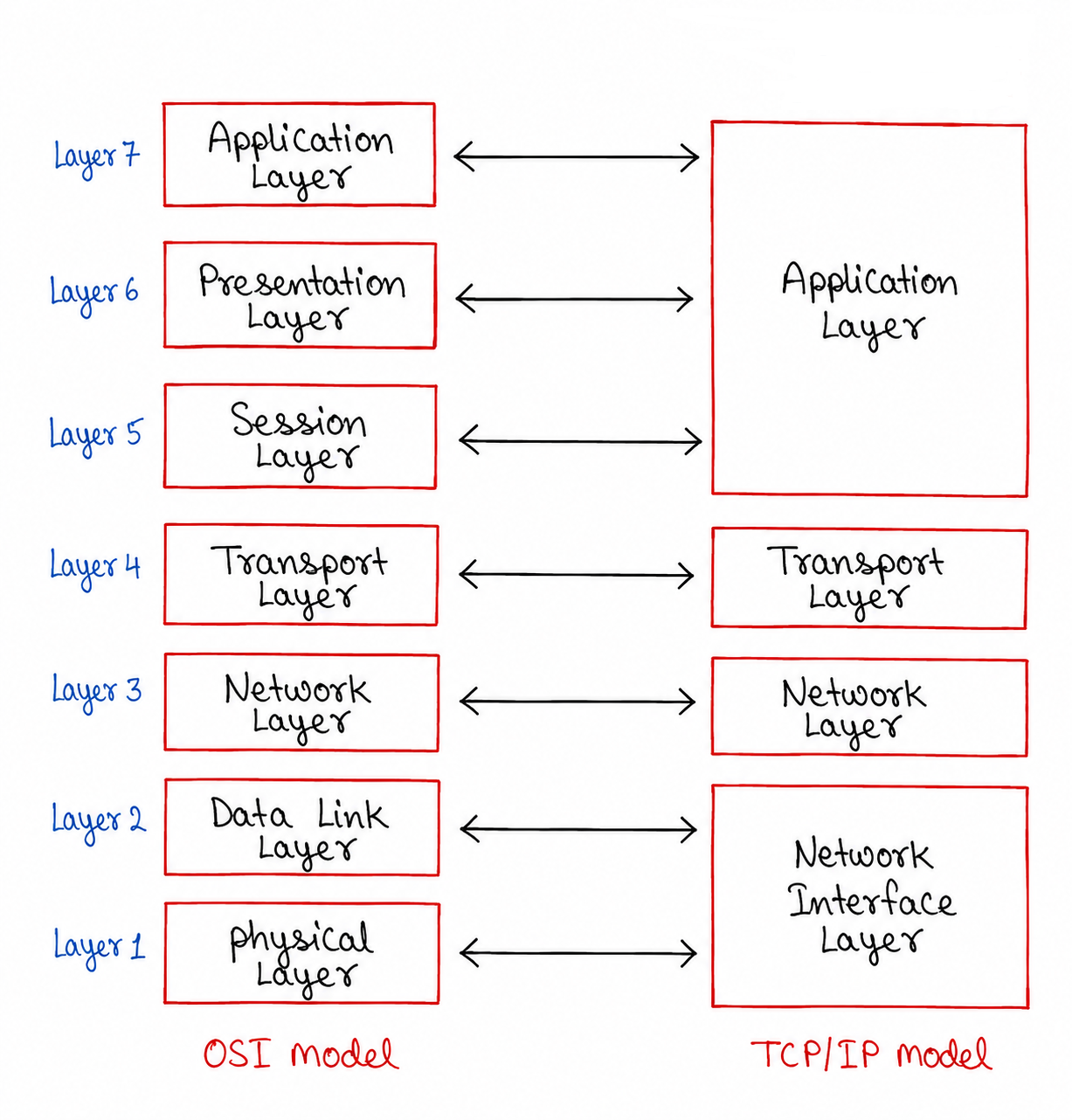
TCP/IP Model Mapping with OSI Model
The TCP/IP Model combines some layers of the OSI Model to create a simpler and more practical architecture.
| OSI Model | TCP/IP Model |
|---|---|
| Application Layer | Application Layer |
| Presentation Layer | |
| Session Layer | |
| Transport Layer | Transport Layer |
| Network Layer | Internet Layer |
| Data Link Layer | Network Interface Layer |
| Physical Layer |
1. Application Layer
The Application Layer is the highest layer of the TCP/IP Model. It provides services directly to user applications and combines the functions of the Application, Presentation, and Session layers of the OSI Model.
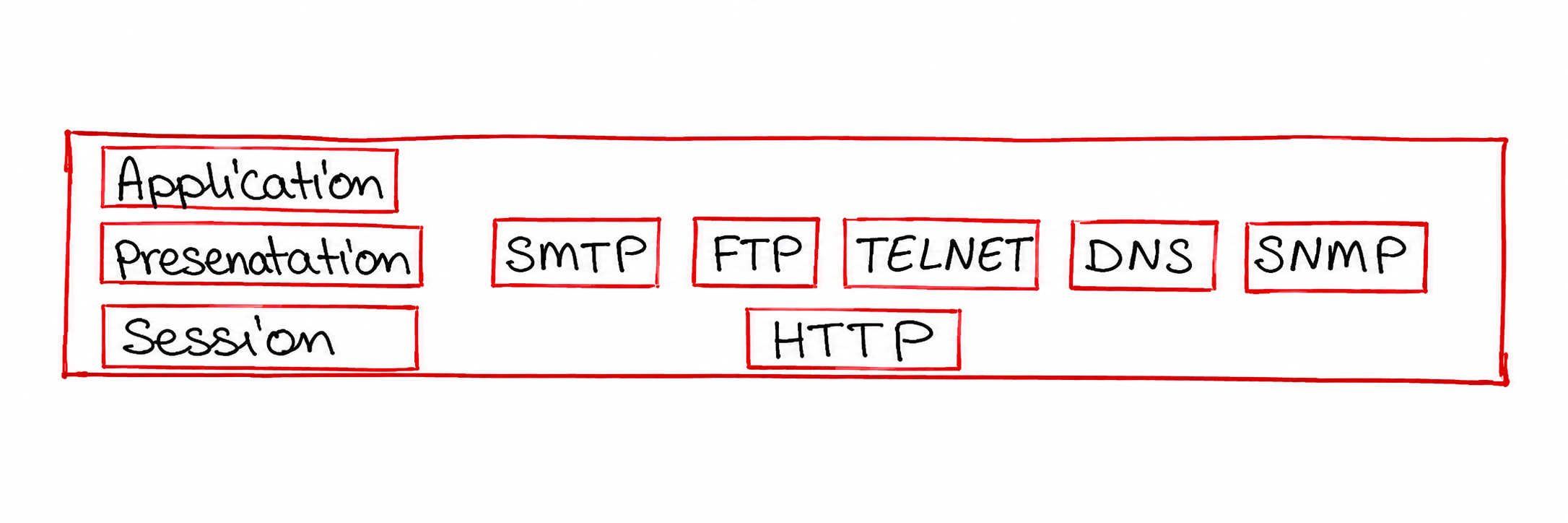
This layer allows software applications to communicate with network services. Activities such as web browsing, email communication, file transfer, and remote access are handled here.
Functions of Application Layer
- Provides network services to users
- Supports web browsing and email communication
- Handles file transfer operations
- Manages remote login services
- Supports network management and monitoring
Common Protocols
- HTTP – Used for web page communication
- FTP – Used for file transfer
- SMTP – Used for sending emails
- TELNET – Used for remote access
- DNS – Converts domain names into IP addresses
- SNMP – Used for network monitoring and management
2. Transport Layer
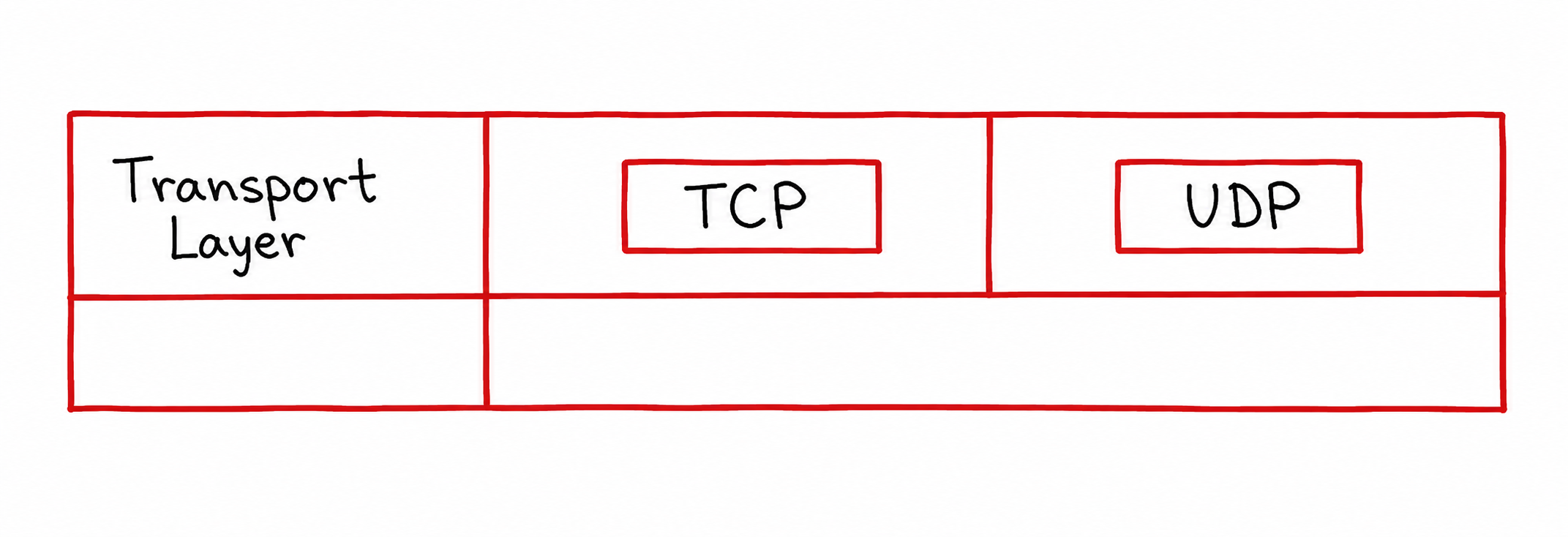
The Transport Layer provides end-to-end communication between devices. It ensures that data reaches the correct application running on the destination device.
Functions of Transport Layer
- End-to-end communication
- Data segmentation and reassembly
- Flow control
- Error detection and recovery
- Port-based communication
Protocols Used
The Transport Layer of the TCP/IP Model primarily uses two important protocols: Transmission Control Protocol (TCP) and User Datagram Protocol (UDP). Both protocols provide end-to-end communication between applications, but they are designed for different networking requirements. TCP focuses on reliability and accuracy, while UDP emphasizes speed and efficiency.
1. TCP (Transmission Control Protocol)
TCP is a connection-oriented protocol that establishes a communication session before data transmission begins. It ensures that data reaches the destination accurately, completely, and in the correct order. If any data segment is lost or damaged during transmission, TCP automatically detects the problem and retransmits the missing data.
- Provides reliable and error-free communication.
- Uses acknowledgments to confirm successful delivery.
- Performs sequencing to maintain correct data order.
- Supports flow control to prevent network congestion.
- Retransmits lost or corrupted packets automatically.
- Suitable for applications where data accuracy is critical.
Examples: Web browsing (HTTP/HTTPS), Email services, File Transfer (FTP), Online Banking, Cloud Storage.
2. UDP (User Datagram Protocol)
UDP is a connectionless protocol that sends data without establishing a dedicated connection between sender and receiver. It does not perform acknowledgments, sequencing, or retransmissions, which reduces overhead and increases transmission speed. Because of its lightweight nature, UDP is commonly used in applications where speed is more important than perfect reliability.
- Provides fast data transmission.
- Does not require connection establishment.
- Has lower overhead compared to TCP.
- No acknowledgment mechanism.
- No retransmission of lost packets.
- Suitable for real-time applications.
Examples: Video Streaming, Online Gaming, Voice over IP (VoIP), Live Broadcasting, DNS Queries.
TCP vs UDP
| Feature | TCP | UDP |
|---|---|---|
| Connection Type | Connection-Oriented | Connectionless |
| Reliability | High | Low |
| Acknowledgment | Required | Not Required |
| Speed | Slower | Faster |
| Error Recovery | Supported | Not Supported |
| Common Usage | Web, Email, File Transfer | Streaming, Gaming, VoIP |
3. Internet Layer
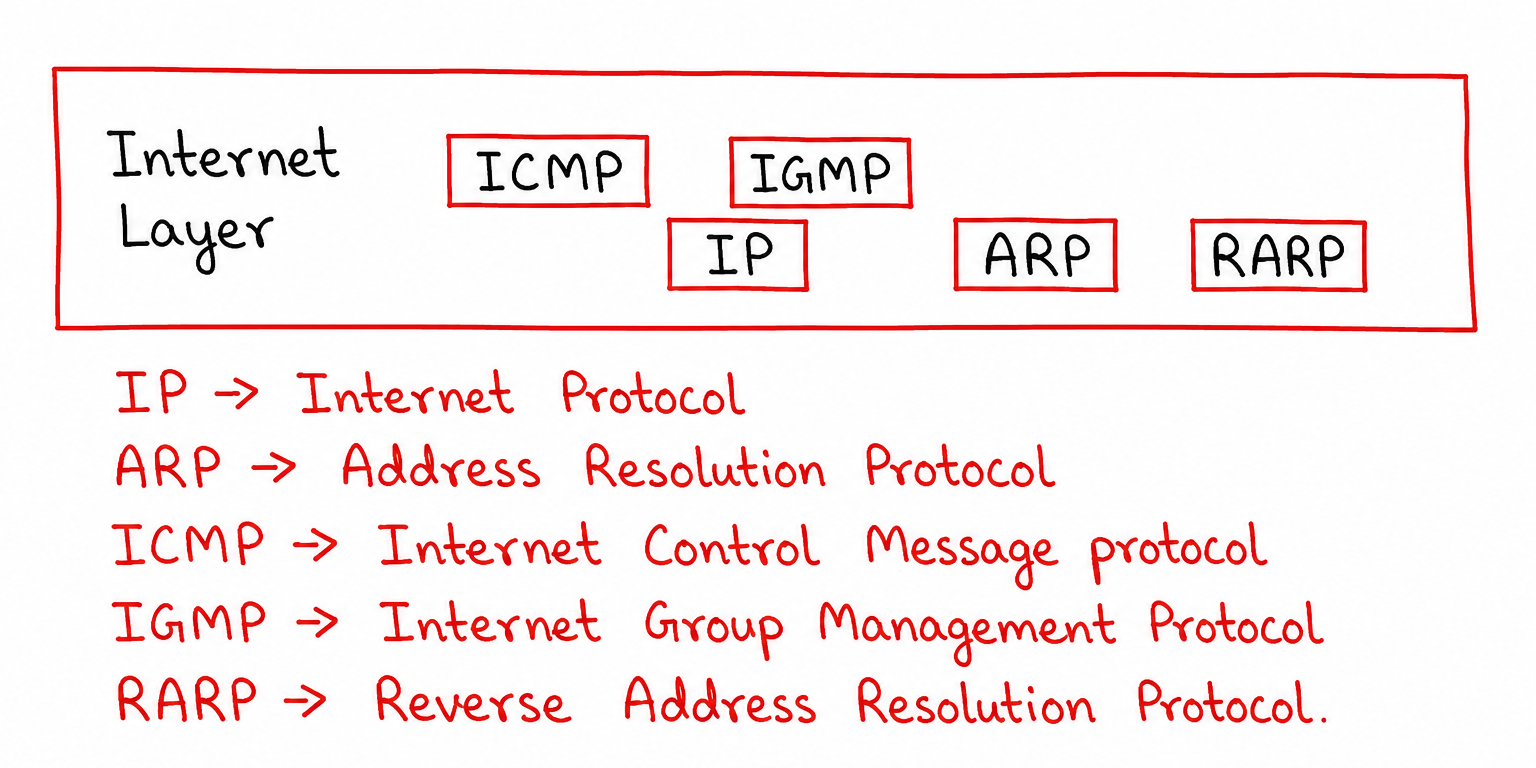
The Internet Layer is responsible for logical addressing and routing. It determines how packets travel from the source device to the destination device across multiple interconnected networks.
Functions of Internet Layer
- Logical addressing using IP addresses
- Packet routing between networks
- Path selection for packet delivery
- Error reporting and diagnostics
- Multicast communication management
Protocols of Internet Layer
- IP (Internet Protocol) – Provides logical addressing and routing.
- ARP (Address Resolution Protocol) – Converts IP addresses into MAC addresses.
- ICMP (Internet Control Message Protocol) – Reports network errors and diagnostics.
- IGMP (Internet Group Management Protocol) – Manages multicast group communication.
- RARP (Reverse Address Resolution Protocol) – Retrieves an IP address using a MAC address.
4. Network Interface Layer
The Network Interface Layer is the lowest layer of the TCP/IP Model. It combines the responsibilities of the Data Link Layer and Physical Layer of the OSI Model.
This layer manages the actual transmission of data through network hardware such as cables, switches, wireless devices, and network adapters.
Functions of Network Interface Layer
- Frame creation and transmission
- Physical addressing using MAC addresses
- Error detection in frames
- Media access control
- Physical transmission of bits
Common Technologies
- Ethernet
- Wi-Fi
- Fiber Optic Networks
- PPP (Point-to-Point Protocol)
How TCP/IP Model Works
When a user sends data through an application, the information travels through all four TCP/IP layers before reaching the network. Each layer adds its own control information to the data. At the receiving side, the process is reversed and each layer removes its corresponding information before delivering the original data to the destination application.
Sender Side
- Application Layer creates user data.
- Transport Layer divides data into segments.
- Internet Layer adds logical addressing information.
- Network Interface Layer converts data into frames and transmits it.
Receiver Side
- Network Interface Layer receives frames.
- Internet Layer processes IP information.
- Transport Layer reassembles segments.
- Application Layer delivers data to the user application.
Data Units in TCP/IP Model
| Layer | Data Unit |
|---|---|
| Application Layer | Data |
| Transport Layer | Segment |
| Internet Layer | Packet |
| Network Interface Layer | Frame / Bits |
Advantages of TCP/IP Model
- Widely used on the internet
- Simple and practical architecture
- Supports communication between different networks
- Scalable for small and large networks
- Reliable communication through TCP
- Supports multiple networking technologies
Limitations of TCP/IP Model
- Layer boundaries are not always clearly defined
- Less detailed than the OSI Model
- Does not separately define Presentation and Session functions
- Troubleshooting can sometimes be more complex
Difference Between OSI Model and TCP/IP Model
The OSI Model and TCP/IP Model are both networking reference models used to describe how data travels from one device to another across a network. While the OSI Model provides a detailed theoretical framework with seven layers, the TCP/IP Model offers a practical approach used in real-world Internet communication. Understanding the differences between these models helps in learning network architecture, protocol design, and data communication processes.
| S.No. | OSI Model | TCP/IP Model |
|---|---|---|
| 1 | OSI stands for Open Systems Interconnection. | TCP/IP stands for Transmission Control Protocol / Internet Protocol. |
| 2 | Developed by the International Organization for Standardization (ISO). | Developed by the United States Department of Defense (DoD). |
| 3 | Contains 7 layers. | Contains 4 layers. |
| 4 | Mainly used as a conceptual and reference model. | Used as the practical networking model for the Internet. |
| 5 | Application, Presentation, and Session are separate layers. | These functions are combined into a single Application Layer. |
| 6 | Clearly separates services, interfaces, and protocols. | Focuses more on protocol implementation and communication. |
| 7 | Network Layer handles routing and addressing. | Internet Layer handles routing and logical addressing. |
| 8 | Data Link Layer and Physical Layer are separate. | Both are combined into the Network Interface Layer. |
| 9 | Designed before widespread Internet adoption. | Designed specifically for internetwork communication. |
| 10 | More detailed and easier for understanding networking concepts. | Simpler and easier to implement in real networks. |
| 11 | Protocols were defined after the model was created. | The model was built around existing communication protocols. |
| 12 | Rarely implemented exactly as defined. | Widely implemented across modern networks and the Internet. |
| 13 | Provides a more granular view of communication functions. | Provides a streamlined architecture for practical communication. |
| 14 | Useful for learning, troubleshooting, and network analysis. | Useful for actual network deployment and operation. |
Summary
The OSI Model provides a detailed seven-layer framework for understanding network communication, while the TCP/IP Model offers a practical four-layer architecture used throughout the Internet. Although their structures differ, both models describe the same fundamental process of transferring data between networked devices. The OSI Model is widely used for learning and analysis, whereas the TCP/IP Model forms the foundation of modern networking systems.
Conclusion
The TCP/IP Model is the backbone of modern networking and internet communication. Its four-layer architecture provides a practical approach for transmitting data between devices. Understanding the TCP/IP Model helps students and professionals learn how websites, emails, file transfers, and other online services operate in real-world networks.