Types of Computer Network
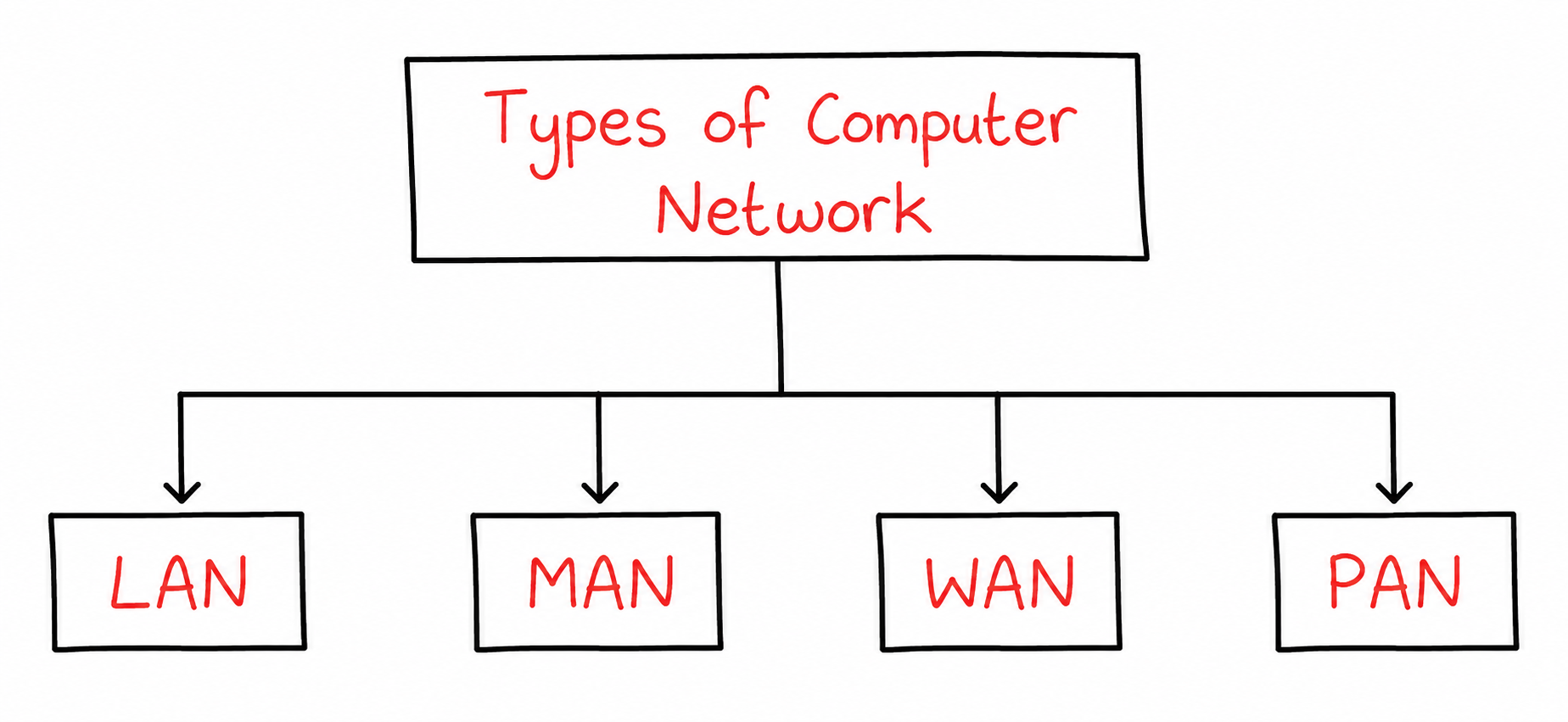
Computer networks can be grouped into different types depending on how large they are, how far they can reach, and what purpose they serve. This classification helps us understand how networks are designed and where they are used in real life. The most commonly studied types of networks include Local Area Network (LAN), Metropolitan Area Network (MAN), and Wide Area Network (WAN), each having its own unique characteristics and applications.
A Local Area Network (LAN) is the smallest and most commonly used type of network. It connects computers and devices within a limited area such as a home, school, office, or laboratory. LANs are known for their high speed, low cost, and easy maintenance. They allow users to share resources like files, printers, and internet connections efficiently within a short distance.
A Metropolitan Area Network (MAN) is larger than a LAN and is designed to cover a city or a large campus. It connects multiple LANs together to form a bigger network. MANs are typically used by organizations, universities, or government institutions that need to connect different locations within the same city. Compared to LAN, a MAN provides wider coverage but may require more complex infrastructure.
A Wide Area Network (WAN) is the largest type of network and can span across countries or even continents. It connects multiple LANs and MANs over long distances using advanced communication technologies such as satellite links, fiber optics, and leased lines. The internet is the best example of a WAN, allowing people around the world to communicate and share information instantly.
In addition to these main types, there are other specialized networks such as Personal Area Network (PAN) for very small personal device connections and Wireless LAN (WLAN) which uses Wi-Fi technology instead of cables. Each type of network is designed to meet specific communication needs, whether it is connecting a few devices in a room or millions of devices globally.
1. Local Area Network (LAN)
A Local Area Network (LAN) is a type of computer network that connects multiple devices within a limited geographical area such as a home, school, office building, or laboratory. It is one of the most widely used network types because it allows users to share data, resources, and applications quickly and efficiently within a short distance.
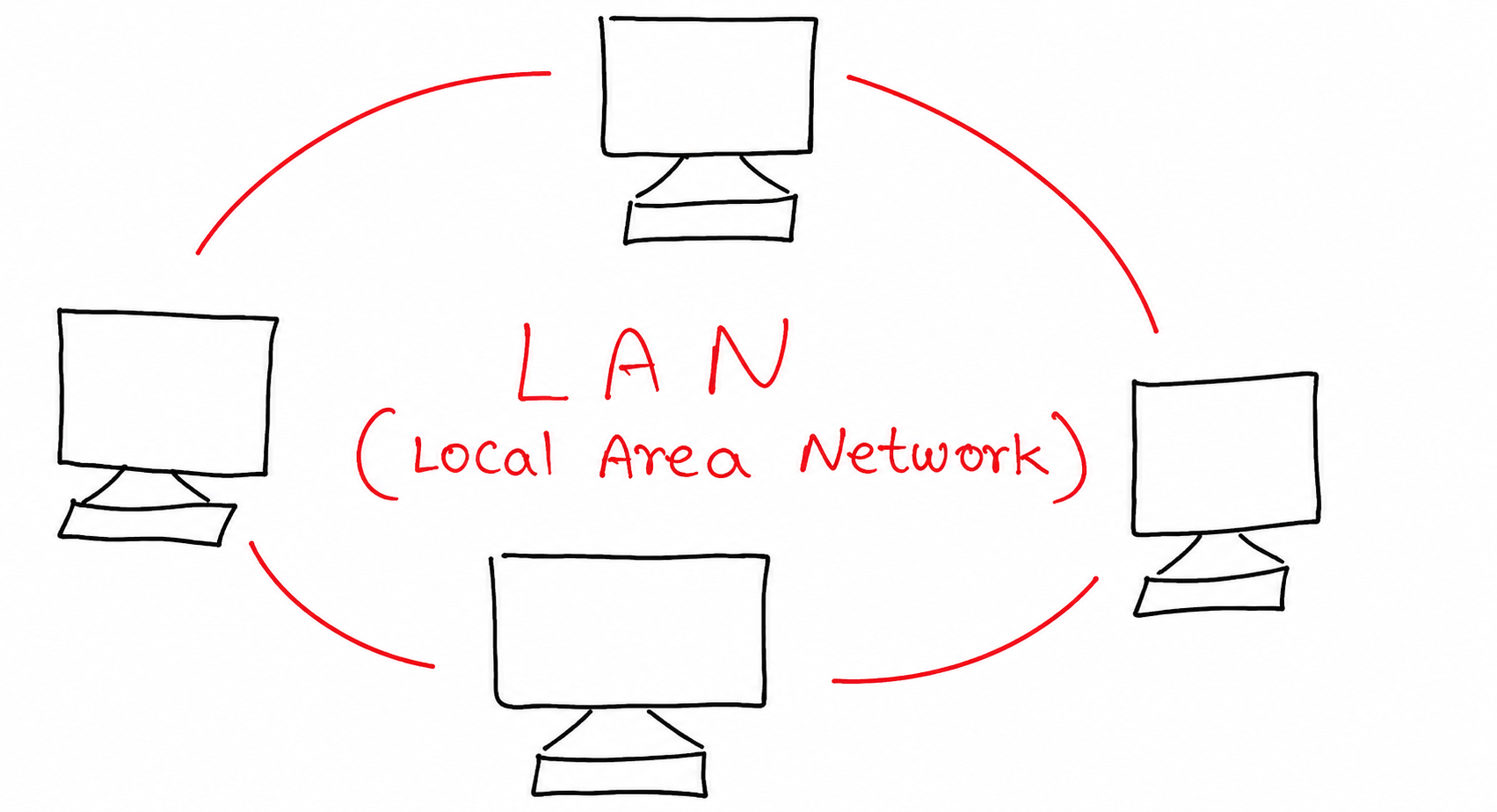
In a LAN, devices such as computers, laptops, printers, and servers are connected using wired technologies like Ethernet cables or wireless technologies like Wi-Fi. Because the network covers a small area, it provides very fast data transfer speeds and stable communication between devices. This makes LAN ideal for environments where quick access to information is important.
LANs are commonly used in educational institutions, business organizations, and even homes. For example, in a school computer lab, all computers are connected through a LAN so that students can access shared files and printers. Similarly, in offices, employees use LAN to communicate, share documents, and access centralized systems.
Another important advantage of LAN is that it is relatively inexpensive to set up and maintain compared to larger networks. Network management is easier because all devices are located within a small area. Security can also be better controlled since access to the network can be restricted to authorized users only.
Features of LAN:
- Provides high-speed data communication within a limited area
- Low installation and maintenance cost compared to larger networks
- Allows sharing of resources such as files, printers, and internet connection
- Easy to set up, manage, and troubleshoot
- Offers better security control due to limited access range
- Commonly used in homes, schools, offices, and computer labs
2. Metropolitan Area Network (MAN)
A Metropolitan Area Network (MAN) is a type of computer network that covers a larger geographical area than a Local Area Network (LAN), typically extending across a city, town, or large campus. It is designed to connect multiple LANs together, allowing communication and data sharing between different locations within the same urban region.
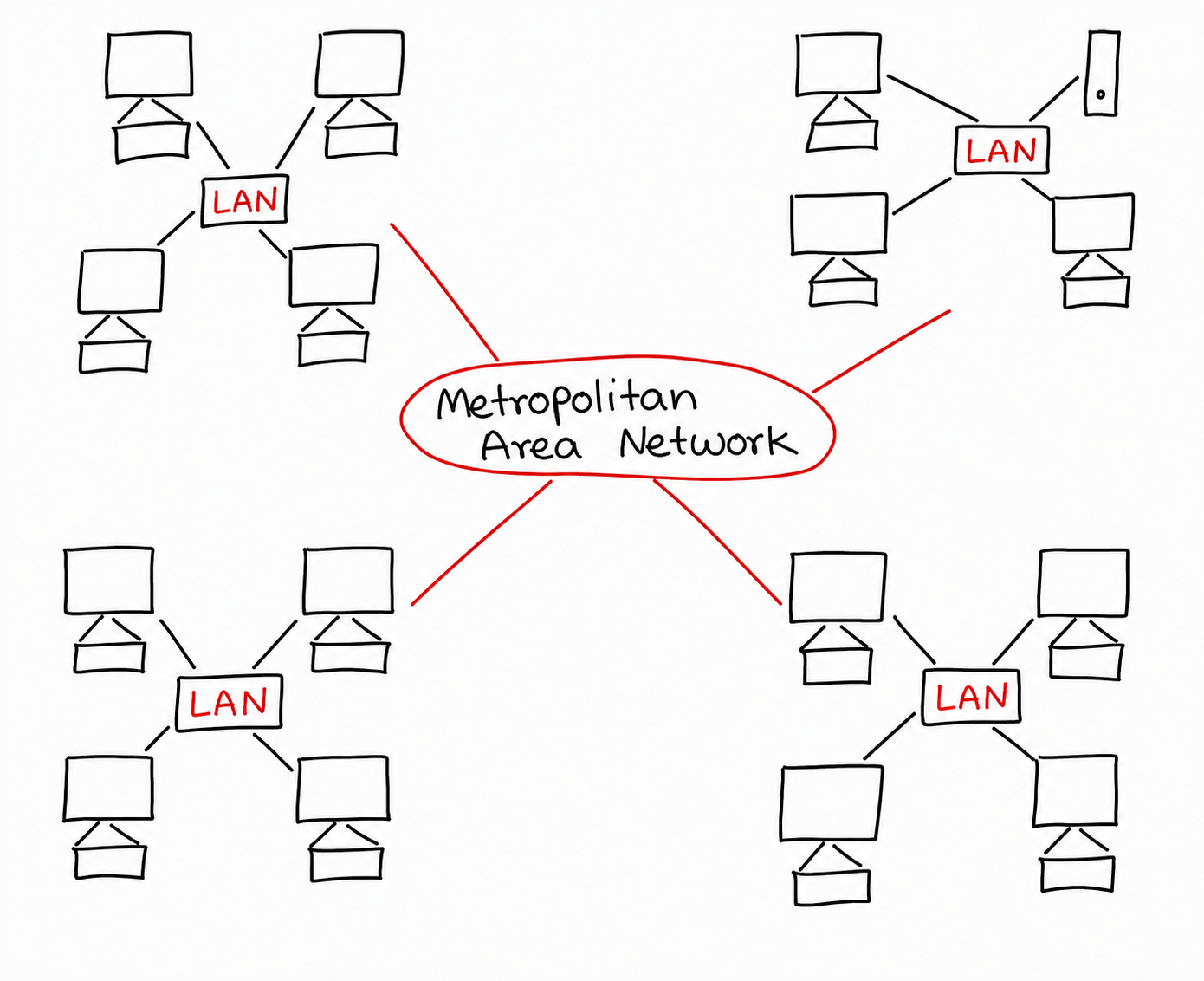
MAN acts as a bridge between smaller networks and larger networks. For example, different offices, colleges, or government buildings located in various parts of a city can be connected through a MAN. This enables users to exchange data, access shared services, and communicate efficiently without being in the same physical location.
Unlike LAN, which is usually owned and managed by a single organization, a MAN may be operated by government bodies, large corporations, or Internet Service Providers (ISPs). It often uses high-capacity communication technologies such as fiber optic cables, microwave links, or wireless transmission systems to ensure reliable and faster data transfer across longer distances.
Although a MAN provides wider coverage and better connectivity between multiple locations, it is more complex and costly to set up compared to a LAN. It requires advanced infrastructure, proper planning, and technical expertise for maintenance. However, it is still more efficient than a Wide Area Network (WAN) when communication is limited to a specific city or region.
In real-life situations, MAN is commonly used in smart cities, banking networks, cable television systems, and large educational institutions where multiple branches need to stay connected within a metropolitan area.
Features of MAN:
- Covers a large geographical area such as a city or town
- Connects multiple LANs to form a bigger network
- Offers moderate to high data transfer speed depending on technology used
- More expensive and complex than LAN in terms of setup and maintenance
- Uses advanced transmission media like fiber optics and wireless links
- Commonly used by government organizations, ISPs, and large institutions
3. Wide Area Network (WAN)
A Wide Area Network (WAN) is a type of computer network that covers a very large geographical area, often extending across cities, countries, or even continents. It is designed to connect multiple smaller networks such as LANs and MANs, allowing devices and users from different parts of the world to communicate with each other.
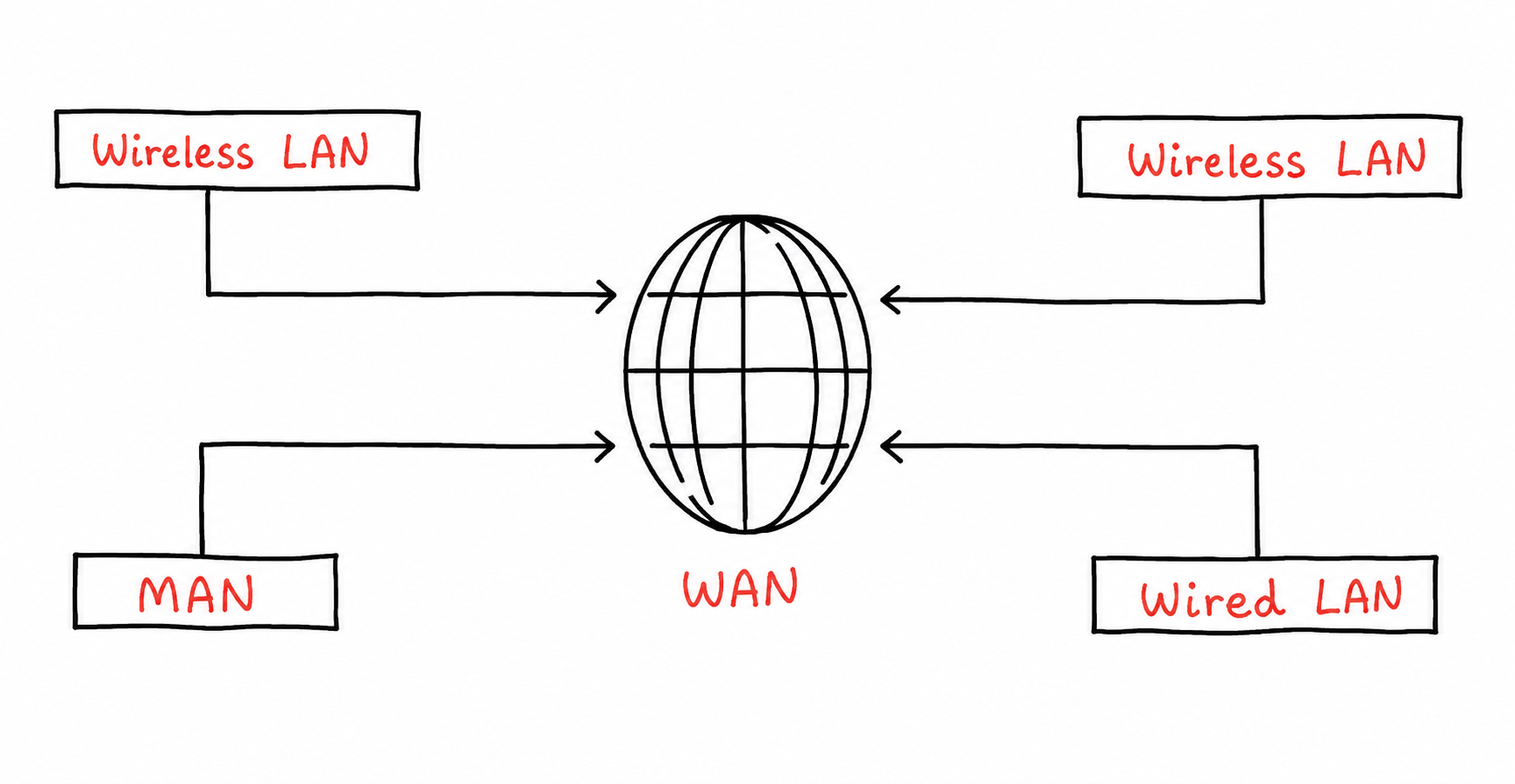
WAN plays a crucial role in modern communication by enabling long-distance data transfer. Unlike LAN and MAN, which are limited to smaller regions, WAN uses advanced technologies such as satellite communication, fiber optic cables, and telecommunication networks to transmit data over vast distances. This makes it possible for organizations and individuals to stay connected regardless of their location.
One of the most common and important examples of a WAN is the Internet. It connects millions of networks worldwide and allows people to access information, send emails, conduct online meetings, and use cloud-based services. Large companies, banks, and multinational organizations also rely on WAN to connect their branch offices located in different countries.
Although WAN provides global connectivity, it is generally more expensive and complex to set up and maintain. It requires high-level infrastructure, specialized hardware, and professional network management. Additionally, because data travels over long distances, the speed of a WAN is usually lower compared to LAN, and it may experience delays or latency.
Despite these challenges, WAN is essential in today’s digital world as it supports global communication, international business operations, and access to worldwide information systems.
Features of WAN:
- Covers extremely large geographical areas such as countries and continents
- Connects multiple LANs and MANs to form a global network
- Uses advanced communication technologies like satellites and fiber optics
- Provides global communication and data sharing capabilities
- More expensive and complex to install and maintain
- Offers comparatively lower speed and higher latency than LAN
4. Personal Area Network (PAN)
A Personal Area Network (PAN) is the smallest type of computer network, designed for connecting devices within a very short range, usually around an individual person. It is used to link personal electronic devices such as smartphones, laptops, tablets, smartwatches, and wireless accessories so they can communicate and share data easily.
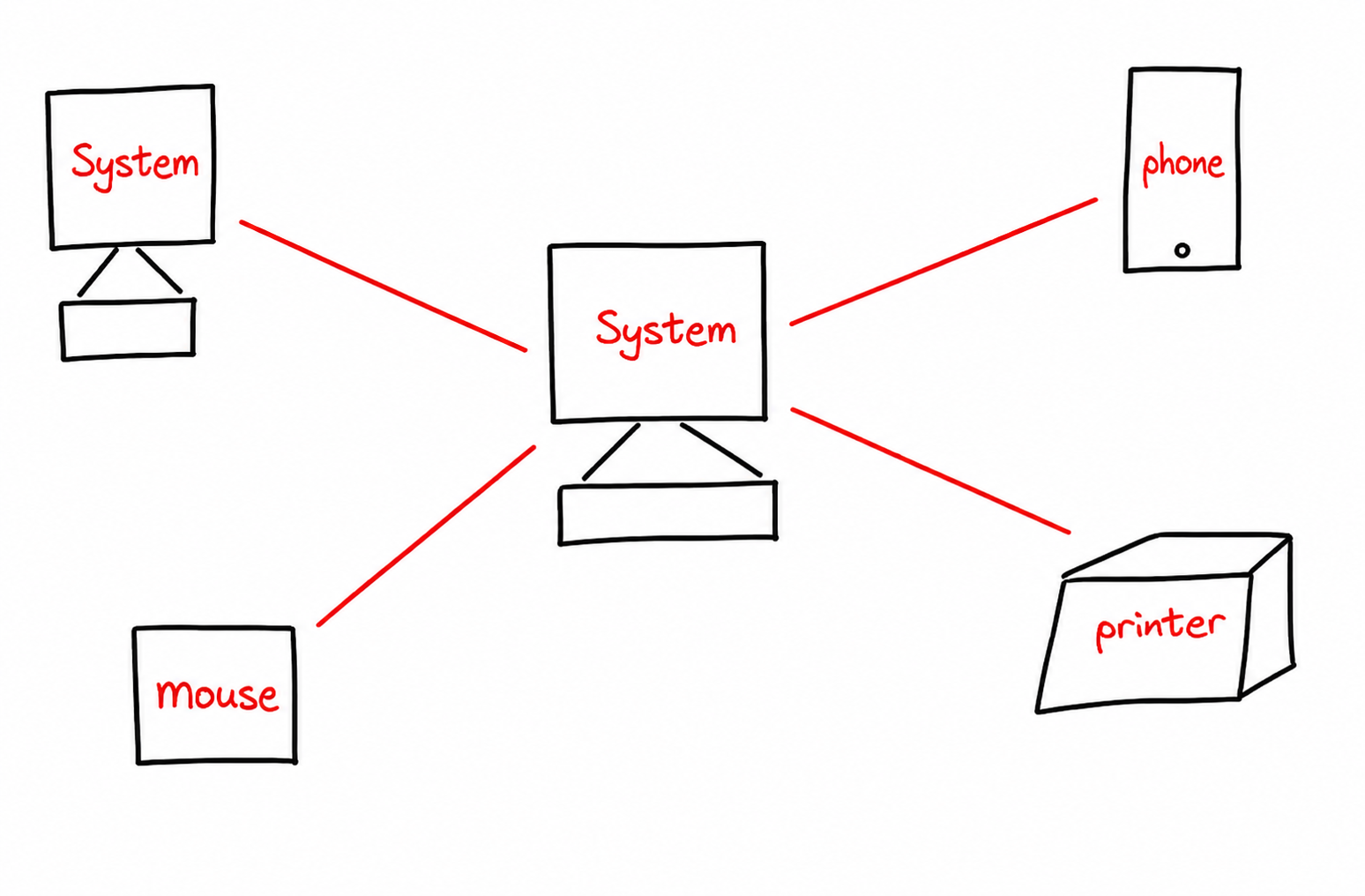
PAN operates within a limited distance, typically a few meters, making it ideal for personal use rather than large-scale communication. These networks can be established using wired connections like USB cables or wireless technologies such as Bluetooth, infrared, and Wi-Fi Direct. Because of its small coverage area, PAN provides quick and convenient communication between nearby devices.
In everyday life, PAN is widely used for tasks like transferring files between mobile devices, connecting wireless headphones, syncing smartwatches with phones, and sharing internet connections through mobile hotspots. It allows users to create a simple and efficient network without needing complex infrastructure.
One of the main advantages of PAN is its ease of setup and low cost, as it does not require advanced networking equipment. However, due to its limited range, it cannot be used for long-distance communication. Despite this limitation, PAN plays an important role in modern digital life by enabling seamless connectivity between personal devices.
Features of PAN:
- Covers a very small area, usually within a few meters
- Connects personal devices such as smartphones, laptops, and wearables
- Uses technologies like Bluetooth, USB, infrared, and Wi-Fi Direct
- Simple and quick to set up without complex infrastructure
- Low cost and energy-efficient network type
- Ideal for personal use such as file sharing and device synchronization
Difference Between PAN, LAN, MAN and WAN
Computer networks can be compared based on their size, speed, cost, and usage. The table below clearly explains the major differences between Personal Area Network (PAN), Local Area Network (LAN), Metropolitan Area Network (MAN), and Wide Area Network (WAN) in a simple and easy-to-understand format.
| Feature | PAN | LAN | MAN | WAN |
|---|---|---|---|---|
| Full Form | Personal Area Network | Local Area Network | Metropolitan Area Network | Wide Area Network |
| Coverage Area | Very small area (within a few meters around a person) | Limited area such as a room, building, or campus | Large area like a city or town | Very large area such as countries or continents |
| Speed | High speed for short-distance communication | Very high speed with stable performance | Moderate speed depending on infrastructure | Lower speed compared to LAN due to long-distance data transfer |
| Cost | Very low cost and easy to set up | Low cost for installation and maintenance | Moderate cost with more infrastructure required | High cost due to complex setup and technologies |
| Ownership | Owned and controlled by an individual user | Usually owned by a private organization or institution | Can be owned by government or private organizations | Shared ownership among multiple organizations or service providers |
| Technology Used | Bluetooth, USB, Infrared, Wi-Fi Direct | Ethernet cables, Wi-Fi networks | Fiber optic cables, wireless transmission systems | Satellite links, fiber optics, telecommunication networks |
| Example | Connecting smartphone with smartwatch or earbuds | School, office, or home network | City-wide internet or cable TV network | Internet and global communication systems |
From the above comparison, it is clear that each type of network serves a different purpose. PAN is used for personal devices, LAN is ideal for small areas, MAN connects larger regions like cities, and WAN enables communication across the world. Choosing the right network depends on the required coverage area, cost, and performance needs.
Conclusion
Each type of network serves a unique purpose. LAN is ideal for small areas, MAN is suitable for city-wide communication, and WAN enables global connectivity. Understanding these types helps in designing efficient and scalable networks.