Spiral Model in Software Engineering
The Spiral Model is one of the most important Software Development Life Cycle (SDLC) models that combines the features of both iterative development and risk management. This model was introduced to handle large, complex, and high-risk software projects where continuous evaluation and improvement are necessary.
In the Spiral Model, software development moves through repeated cycles called spirals. Each loop of the spiral represents one phase of the development process. During every cycle, developers identify objectives, analyze risks, build prototypes or product versions, and evaluate the results before moving to the next phase.
Unlike traditional linear models, the Spiral Model focuses heavily on risk analysis. This helps organizations identify potential problems early and reduce the chances of project failure. Because of its flexible nature, the model is widely used in large-scale and mission-critical systems.
Spiral Model Diagram
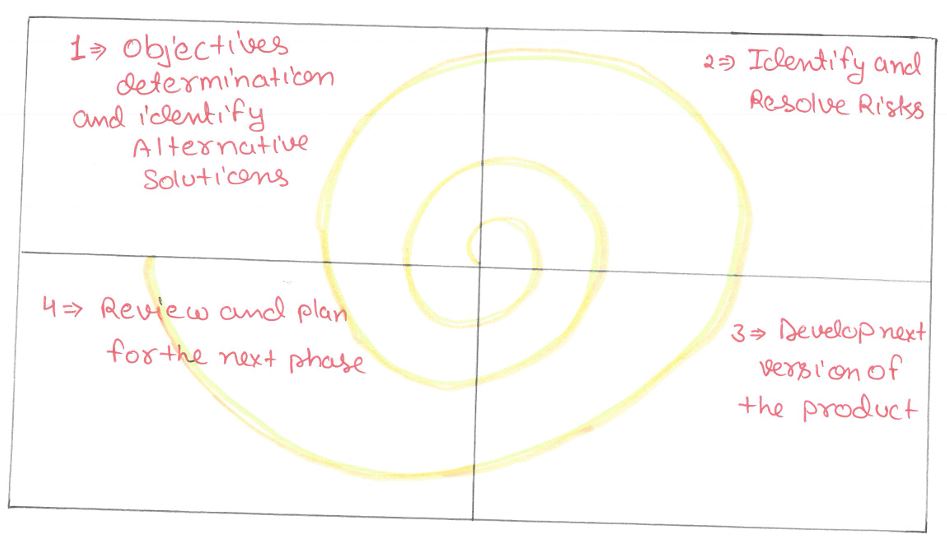
As shown in the diagram, the Spiral Model consists of four major activities that repeat in every cycle: objective determination, risk analysis, development of the next version, and planning for the next phase. The spiral continues outward until the complete software product is developed.
Phases of Spiral Model
1. Objective Determination and Identify Alternative Solutions
The first phase of the Spiral Model focuses on understanding the main objectives of the project and identifying different ways to achieve those objectives. This phase acts as the foundation for the entire development process because every future activity depends on the clarity of goals defined here.
At the beginning of this stage, developers, system analysts, project managers, clients, and other stakeholders conduct detailed discussions to understand the exact purpose of the software. They identify what problem the system is expected to solve, what features users require, and what business goals need to be achieved through the software application.
Unlike traditional software development models where all requirements are finalized at once, the Spiral Model allows requirements to evolve gradually. Therefore, this phase does not only focus on gathering current requirements but also attempts to understand future expectations, possible changes, and long-term project needs.
During objective determination, the development team carefully studies several important factors such as project scope, system functionality, user expectations, performance requirements, security concerns, budget limitations, and delivery deadlines. These elements help in creating a clear roadmap for the project.
One of the most important activities in this phase is identifying alternative solutions. Instead of directly selecting a single development approach, the team explores multiple options that can be used to build the system effectively.
For example, developers may compare different programming languages, frameworks, database systems, cloud platforms, development methodologies, or software architectures. They may also evaluate whether the application should be developed as a desktop application, web application, mobile application, or hybrid system depending on user requirements.
Alternative solutions are important because every technology or design approach has its own advantages, limitations, costs, and risks. By comparing different solutions early, the development team can select the most suitable approach for the project.
This phase also includes feasibility analysis. Developers analyze whether the proposed system can be developed successfully within available resources and constraints. Feasibility analysis generally includes:
-
Technical Feasibility:
Determines whether the required technology, tools, and technical expertise are available for the project. -
Economic Feasibility:
Evaluates whether the project can be completed within the available budget and whether it will provide long-term business value. -
Operational Feasibility:
Checks whether the system will function effectively in the real working environment and whether users will be able to operate it efficiently. -
Schedule Feasibility:
Examines whether the project can be completed within the expected time period.
Another major objective of this phase is reducing uncertainty. In many software projects, clients may not fully understand what they actually need during the initial stages. By discussing objectives and exploring alternatives, the Spiral Model helps both developers and customers gain better clarity about the project.
The outputs of this phase usually include preliminary requirement documents, possible solution strategies, project constraints, estimated costs, timelines, and planning details for the next phase of the spiral.
Overall, the Objective Determination and Identify Alternative Solutions phase provides a structured beginning for the Spiral Model. It ensures that the project starts with clear goals, realistic expectations, and multiple solution options, which helps developers make informed decisions throughout the software development process.
2. Identify and Resolve Risks
The second phase of the Spiral Model is one of the most important stages because it focuses on identifying, analyzing, and resolving risks associated with the software project. This phase makes the Spiral Model different from many other Software Development Life Cycle (SDLC) models, as risk management becomes a central activity throughout the development process.
In software engineering, a risk refers to any uncertain event or condition that may negatively affect the project’s success. Risks can create problems related to project cost, development time, software quality, system performance, security, or customer satisfaction. If risks are not handled properly at an early stage, they may lead to project failure, financial loss, or poor software reliability.
During this phase, developers, project managers, analysts, and stakeholders work together to carefully examine every possible issue that could affect the system. The main objective is not only to identify risks but also to find practical solutions to minimize or completely eliminate them before moving to the next development stage.
Risk identification begins with detailed analysis of the project requirements, technical environment, available resources, and development strategies. The development team studies different aspects of the project to determine where problems are most likely to occur.
The Spiral Model considers several categories of risks during this phase, including:
-
Technical Risks:
These risks are related to technology, tools, programming languages, frameworks, databases, hardware compatibility, or system integration issues. For example, using a new technology that the development team has never used before may increase uncertainty and technical complexity. -
Requirement Risks:
Sometimes customer requirements are incomplete, unclear, or change frequently. Such situations can create confusion during development and may affect software functionality and project planning. -
Performance Risks:
These risks occur when there is uncertainty regarding the speed, efficiency, scalability, or response time of the software system. Developers must ensure that the application performs well under expected workloads. -
Security Risks:
Modern software systems often handle sensitive data and online transactions. Security risks include data breaches, unauthorized access, weak authentication mechanisms, or cyber attacks. -
Financial Risks:
Budget-related risks arise when project costs exceed estimated expenses due to additional requirements, delays, or resource limitations. -
Schedule Risks:
These risks are associated with project deadlines and delivery schedules. Delays in development, testing, or resource allocation can increase project duration. -
Operational Risks:
Operational risks occur when the final system may not function properly in the actual working environment or may fail to meet business expectations.
After identifying possible risks, the next step is risk analysis. In this activity, developers evaluate how serious each risk is and estimate the probability of its occurrence. Risks with higher impact and higher probability receive greater attention because they can cause major problems in the project.
The development team then prepares strategies to resolve or reduce identified risks. These strategies are known as risk mitigation techniques. The goal is to minimize uncertainty and improve confidence in the development process.
One of the most effective methods used in this phase is prototype development. When a particular feature or technology appears risky, developers create a small prototype or experimental model to test its feasibility. This helps them understand whether the selected solution will work properly before implementing it in the final software system.
For example, if developers are unsure whether a system can handle a large number of users, they may build a performance prototype to test scalability and response time. Similarly, if a new technology is being used, a prototype can help evaluate its compatibility and reliability.
In addition to prototyping, developers may also use simulations, proof-of-concept models, pilot systems, security testing, and alternative technology evaluations to reduce project risks.
Another important activity in this phase is decision-making. After analyzing risks and possible solutions, the project team selects the safest and most efficient approach for the next stage of development. If risks are considered too high, changes may be made to requirements, technology selection, project planning, or design strategy.
This phase also improves communication between stakeholders and developers. By discussing risks openly, both parties gain a better understanding of project challenges, limitations, and expectations. This transparency helps avoid misunderstandings later in the project.
The Identify and Resolve Risks phase plays a major role in improving software quality, project stability, and development reliability. Because risks are addressed early and continuously, the chances of major failures are significantly reduced.
Overall, this phase makes the Spiral Model highly suitable for large-scale, complex, and mission-critical software projects where careful planning, continuous evaluation, and risk management are essential for success.
3. Develop Next Version of the Product
After risks have been carefully identified, analyzed, and minimized in the previous phase, the development team proceeds to build the next version of the software product. This phase represents the actual engineering and construction stage of the Spiral Model, where ideas, plans, and solutions are transformed into a working software system.
The primary objective of this phase is to create an improved version of the software based on the objectives defined earlier and the solutions selected after risk analysis. Every cycle of the Spiral Model produces a more advanced and refined version of the product, gradually moving the project closer to the final complete system.
At the beginning of this stage, developers prepare detailed system designs and technical plans. These designs describe how different parts of the system will work together, how data will flow through the application, and how user interactions will be managed. The design process generally includes system architecture design, database design, module design, interface design, and workflow planning.
Once the design activities are completed, developers begin the coding process. Programmers convert the planned design into actual source code using suitable programming languages, frameworks, tools, and technologies. Different modules and functionalities are developed according to project requirements.
Depending on the size and complexity of the project, development may involve:
-
User Interface Development:
Creating screens, forms, dashboards, navigation systems, and interactive components for users. -
Backend Development:
Implementing business logic, server-side processing, APIs, authentication systems, and data handling mechanisms. -
Database Development:
Designing and implementing databases for efficient storage, retrieval, and management of information. -
System Integration:
Connecting different modules and external services so that the software functions as a complete system. -
Security Implementation:
Adding authentication, authorization, encryption, and other security features to protect the system and user data.
Testing is also an important part of this phase. As development progresses, developers continuously test individual modules, functions, and components to ensure that they are working correctly. This helps detect errors early and improves overall software quality.
Different types of testing may be performed during this stage, such as:
- Unit Testing
- Integration Testing
- Functional Testing
- Performance Testing
- Security Testing
One of the major advantages of the Spiral Model during this phase is gradual development. Instead of building the entire system at once, the software grows step by step. Each iteration introduces new features, improvements, optimizations, and corrections based on previous evaluations and customer feedback.
For example, in the first cycle, developers may create only the basic structure of the application with limited functionality. In the next cycle, advanced features, improved user interfaces, and additional modules are added. This gradual enhancement continues until the software becomes fully functional.
Another important feature of this phase is flexibility. Since development occurs in multiple cycles, changes can be incorporated easily without affecting the entire project. If users request modifications or improvements, developers can implement them in future iterations.
The iterative nature of the Spiral Model also improves software reliability. Continuous development and repeated testing ensure that defects are corrected regularly, making the product more stable with every cycle.
In large-scale software projects, this phase may also include documentation activities. Technical documents, design reports, coding guidelines, and user manuals are updated continuously as the system evolves. Proper documentation helps future maintenance and system upgrades.
Overall, the Develop Next Version of the Product phase transforms project plans into an operational software system. Through continuous design, coding, testing, and enhancement, the Spiral Model gradually produces a high-quality, reliable, and feature-rich software application.
4. Review and Plan for the Next Phase
The fourth phase of the Spiral Model focuses on evaluating the current version of the software and planning the activities for the next development cycle. This phase is extremely important because it helps determine whether the project is progressing in the right direction and whether the objectives of the current iteration have been achieved successfully.
After the latest version of the software has been developed, it is presented to customers, end users, project managers, analysts, and other stakeholders for review and evaluation. The purpose of this review is to examine the software carefully and collect valuable feedback regarding its functionality, performance, usability, reliability, and overall quality.
During the review process, stakeholders analyze whether the software:
- Meets user requirements and business objectives
- Functions correctly without major errors
- Provides a satisfactory user experience
- Performs efficiently under expected workloads
- Follows security and quality standards
Customers and users may suggest additional features, identify missing functionalities, or recommend design improvements. This feedback becomes highly valuable for future iterations of the project.
One of the major strengths of the Spiral Model is continuous customer involvement. Unlike traditional models where users see the product only after final completion, the Spiral Model allows them to evaluate the software regularly throughout development. This reduces misunderstandings and ensures that the final product aligns closely with user expectations.
The review phase also includes technical evaluation by the development team. Developers analyze system performance, code quality, integration results, security measures, testing outcomes, and unresolved issues from the current cycle.
Project managers examine factors such as:
- Project progress and milestone completion
- Budget utilization and cost management
- Resource allocation and team performance
- Development timelines and scheduling
- Remaining project risks and uncertainties
After reviewing the current version, planning for the next iteration begins. This planning activity is essential because the Spiral Model follows a continuous cycle of improvement and expansion.
During planning, the development team identifies:
- New objectives for the next cycle
- Additional features to be developed
- Technical improvements and optimizations
- Budget and resource requirements
- Time schedules and deadlines
- Potential risks for future development
Based on these decisions, a roadmap for the next spiral cycle is prepared. This roadmap guides the development team in the upcoming iteration.
Another important benefit of this phase is quality improvement. Continuous reviews and evaluations help identify weaknesses at an early stage, allowing developers to fix issues before they become major problems. As a result, software quality improves significantly over time.
The planning process also increases project flexibility. Since development occurs iteratively, changes in requirements or business goals can be incorporated smoothly. This makes the Spiral Model highly adaptable to dynamic and evolving projects.
Overall, the Review and Plan for the Next Phase stage ensures continuous monitoring, evaluation, and improvement throughout the software development process. It strengthens communication between developers and stakeholders, enhances software quality, and prepares the project effectively for future development cycles.
Working of Spiral Model
The Spiral Model works through a continuous sequence of repeated development cycles known as spirals. Each spiral represents one complete iteration of the software development process. The model begins from the center of the spiral and gradually moves outward as the project progresses and the software becomes more advanced.
Every loop of the spiral passes through four major phases: objective determination, risk analysis, product development, and review with planning for the next cycle. These phases are repeated continuously until the final software product is completed successfully.
At the start of the project, only basic requirements and initial objectives are identified. The first spiral generally focuses on understanding the system concept, analyzing major risks, and developing a simple preliminary version of the software. This initial version may contain limited functionality but helps establish the foundation for future development.
Once the first iteration is completed, the software enters the second spiral. During this cycle, additional requirements are analyzed, more risks are identified and resolved, and new functionalities are added to the system. Each new spiral produces a more refined and feature-rich version of the software.
As the spirals continue expanding outward, the software gradually evolves from a simple prototype into a complete and fully functional application. The size of each spiral generally depends on the complexity of the project, the number of features being developed, and the level of risk involved.
One of the defining characteristics of the Spiral Model is its strong emphasis on risk management. Before any major development activity is performed, possible risks are carefully evaluated. This proactive approach helps developers avoid costly mistakes and reduces the chances of project failure.
Another important aspect of the Spiral Model is continuous customer feedback. At the end of every cycle, users and stakeholders review the developed version of the software and provide suggestions for improvement. This feedback helps developers understand user expectations more clearly and make necessary modifications in future iterations.
The Spiral Model also supports flexibility in requirement handling. In many real-world projects, requirements change frequently due to market demands, business changes, or technological advancements. Since the model follows iterative development, new requirements can be added easily during future spirals without restarting the entire project.
The working process of the Spiral Model can be summarized as follows:
- Identify project objectives and alternative solutions
- Analyze risks and select the safest approach
- Design, develop, and test the software version
- Review the developed product with stakeholders
- Plan improvements and begin the next iteration
This sequence continues repeatedly until all requirements are fulfilled and the software achieves the desired quality and functionality.
Because of its structured yet flexible nature, the Spiral Model is widely used for large, complex, high-budget, and mission-critical projects where careful planning and continuous evaluation are essential.
Overall, the Spiral Model provides a balanced approach to software development by combining iterative enhancement, customer feedback, risk management, and systematic planning. This makes it one of the most reliable and effective models for modern software engineering projects.
Characteristics of Spiral Model
-
Risk-Driven Development:
The Spiral Model focuses strongly on identifying and resolving risks before moving to the next stage. This reduces the possibility of project failure. -
Iterative Process:
Development takes place through multiple iterations or cycles. Each cycle improves the previous version of the software. -
Flexible Requirement Handling:
Requirements can be modified and updated during the development process, making the model highly flexible. -
Customer Involvement:
Customers actively participate in reviewing every iteration, ensuring that the final product meets user expectations. -
Combination of Multiple Models:
The Spiral Model combines features of prototyping, waterfall, and iterative development approaches.
Advantages of Spiral Model
-
Better Risk Management:
Risks are identified and resolved early, which improves project reliability and reduces development failure. -
Suitable for Large Projects:
The model works effectively for large, complex, and high-budget projects where detailed planning and continuous evaluation are required. -
Continuous Customer Feedback:
Customers review the software after every iteration, leading to better user satisfaction and improved software quality. -
Easy Requirement Changes:
Requirements can be updated at later stages without affecting the entire development process significantly. -
Improved Software Quality:
Continuous testing, evaluation, and refinement help produce highly reliable and efficient software systems.
Disadvantages of Spiral Model
-
High Development Cost:
Repeated risk analysis, planning, and iterations increase the overall development cost of the project. -
Complex Management:
Managing multiple cycles, risk assessments, and continuous reviews can become difficult for project managers. -
Requires Expert Risk Analysis:
The success of the model depends heavily on accurate risk analysis. Poor risk management may lead to project failure. -
Not Suitable for Small Projects:
For small and simple applications, the Spiral Model becomes unnecessarily expensive and time-consuming. -
Longer Development Time:
Multiple iterations and detailed evaluations may increase the overall development duration.
When to Use Spiral Model
The Spiral Model is best suited for large, complex, and high-risk projects where requirements may change frequently during development. It is commonly used in banking systems, defense applications, aerospace software, healthcare systems, and enterprise-level solutions.
This model is also useful when continuous customer feedback, risk management, and gradual system improvement are required.
Difference Between Spiral Model and Prototyping Model
| Spiral Model | Prototyping Model |
|---|---|
| Focuses mainly on risk analysis and iterative development. | Focuses mainly on building prototypes for requirement understanding. |
| Suitable for large and high-risk projects. | Suitable for projects with unclear requirements. |
| More complex and costly. | Relatively simpler and less expensive. |
| Risk management is a major activity. | User feedback is the central activity. |
Conclusion
The Spiral Model is a powerful software development approach that combines iterative development with effective risk management. By continuously analyzing risks and improving the system, it helps organizations build reliable and high-quality software products.
Although it may increase cost and complexity, the model is extremely valuable for large-scale and mission-critical applications where careful planning and flexibility are essential.