Waterfall Model in Software Engineering
The Waterfall Model is one of the earliest and most traditional models used in software development. It follows a linear and sequential approach where each phase must be completed before the next phase begins. Because of its step-by-step nature, it is called the “Waterfall” model, as progress flows steadily downward like a waterfall.
This model is best suited for projects where requirements are clearly defined, well understood, and unlikely to change during development. Each phase has specific goals, deliverables, and review processes, making the model easy to understand and manage.
Waterfall Model Diagram
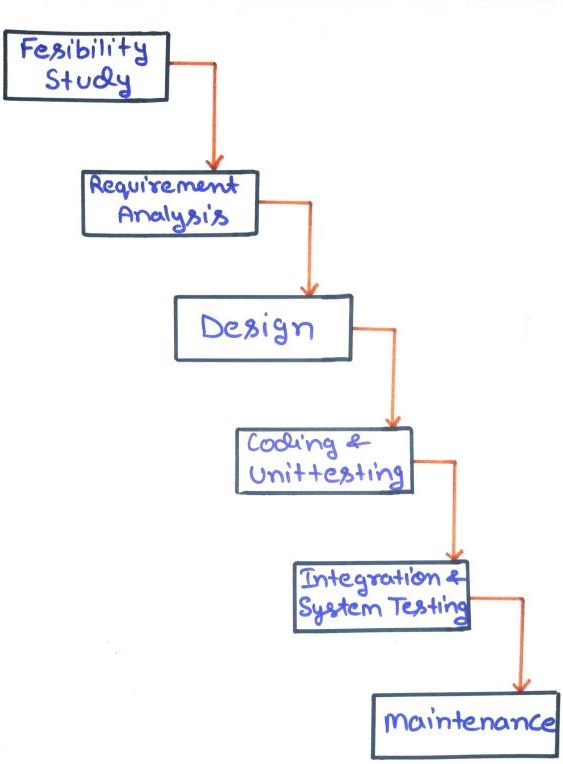
As shown in the diagram, the Waterfall Model progresses through a fixed sequence of phases. Once a phase is completed, it is difficult to return to a previous stage, which makes careful planning extremely important.
Phases of Waterfall Model
1. Feasibility Study
The feasibility study is the very first and most critical phase of the Waterfall Model. In this phase, the proposed software project is carefully evaluated to determine whether it is practical, achievable, and worth developing. Before any detailed planning, design, or coding begins, organizations must ensure that the project can be completed successfully using available resources and within defined constraints.
The primary objective of the feasibility study is to answer a fundamental question: Should this project be developed or not? To reach this decision, the development team examines multiple aspects of feasibility, including cost, legal constraints, operational readiness, technical capability, and time schedules. The outcome of this phase helps management avoid investing in projects that are risky, impractical, or economically unviable.

As shown in the diagram, feasibility study is not limited to a single factor. Instead, it consists of several interconnected feasibility analyses that together provide a complete picture of the project’s viability. Each type of feasibility focuses on a specific area of concern.
1. Economic Feasibility
Economic feasibility evaluates whether the project is financially justified. This analysis focuses on comparing the expected benefits of the software system with the estimated costs involved in its development and maintenance.
Costs may include development expenses, hardware and software purchases, employee salaries, training, and ongoing maintenance. Benefits may include increased efficiency, reduced operational costs, improved productivity, or higher revenue. If the benefits outweigh the costs, the project is considered economically feasible.
2. Legal Feasibility
Legal feasibility examines whether the proposed software system complies with all relevant laws, regulations, and legal requirements. This includes checking software licensing rules, data protection laws, intellectual property rights, industry regulations, and contractual obligations.
For example, applications handling personal or financial data must follow data privacy laws. If a project violates legal standards or exposes the organization to legal risks, it may be rejected even if it is technically sound.
3. Operational Feasibility
Operational feasibility determines whether the organization and its users are ready to adopt and use the new system effectively. It focuses on human factors, workflows, and operational procedures rather than technology.
This analysis evaluates whether users will accept the system, whether sufficient training can be provided, and whether the system will integrate smoothly into existing business operations. A system that is technically strong but difficult to use or resistant to adoption may fail operationally.
4. Technical Feasibility
Technical feasibility assesses whether the organization has the required technology, infrastructure, and technical expertise to develop and run the software system. This includes evaluating hardware, software platforms, programming languages, databases, networks, and development tools.
It also examines whether the development team has the necessary skills and experience. If the required technology is unavailable or too complex to manage, the project may face serious implementation risks.
5. Schedule Feasibility
Schedule feasibility analyzes whether the project can be completed within the given time frame. This involves estimating development duration, identifying critical milestones, and assessing the impact of deadlines.
Projects with unrealistic timelines often suffer from poor quality, incomplete features, and team burnout. If the required schedule cannot be met without compromising quality or exceeding costs, the project may be considered schedule-infeasible.
At the end of the feasibility study phase, all findings are documented in a Feasibility Report. This report provides management with clear recommendations and helps them decide whether to approve, modify, postpone, or reject the project.
A well-conducted feasibility study reduces uncertainty, minimizes risk, and lays a strong foundation for the remaining phases of the Waterfall Model. It ensures that only practical and valuable projects move forward into requirement analysis and system design.
2. Requirement Analysis and Specification
The Requirement Analysis and Specification phase is the second and one of the most critical stages of the Waterfall Model. In this phase, the development team works closely with users, clients, and other stakeholders to thoroughly understand their needs, expectations, and problems that the software is intended to solve. The aim is to clearly identify what the system should do, rather than how it will be developed.
During this stage, various techniques such as interviews, questionnaires, meetings, observations, and document analysis are used to gather accurate and complete requirements. Special attention is given to both functional requirements (features and operations the system must perform) and non-functional requirements (performance, security, reliability, usability, scalability, and legal constraints).
All collected requirements are carefully analyzed to remove ambiguities, conflicts, and inconsistencies. The requirements are then organized, prioritized, and validated to ensure they are realistic, achievable, and aligned with business objectives. This helps reduce misunderstandings and costly changes in later phases of development.
After analysis, the requirements are documented in a structured and detailed document called the Software Requirement Specification (SRS). The SRS serves as an official agreement between the client and the development team. It clearly defines the system scope, system behavior, constraints, assumptions, and acceptance criteria.
The SRS document plays a vital role throughout the software life cycle. It acts as a reference point for system design, coding, testing, and maintenance. A well-prepared requirement specification ensures better planning, accurate cost estimation, reduced development risks, and higher customer satisfaction.
3. System Design
The System Design phase is the third stage of the Waterfall Model, where the requirements approved in the previous phase are transformed into a complete technical framework. This phase focuses on defining how the system will be built by creating a clear and structured design that developers can follow during implementation.
In this stage, architects and designers decide the overall system architecture, hardware and software requirements, programming languages, frameworks, databases, and communication mechanisms. The aim is to create a design that is efficient, scalable, secure, and capable of meeting both current and future needs of the organization.
System Design acts as a bridge between requirement analysis and coding. A well-planned design helps reduce development errors, improves system performance, and ensures smooth integration of different system components.
Types of System Design
System design is generally divided into two major types:
1. High-Level Design (HLD)
High-Level Design provides a broad overview of the system architecture. It defines the main components of the system and how they interact with each other. This design focuses on the overall structure rather than detailed implementation.
High-Level Design typically includes:
- System architecture diagrams
- Module and subsystem identification
- Data flow between modules
- Database overview and major entities
- Technology stack and platform selection
HLD helps stakeholders and developers understand the system at a conceptual level and ensures that the design aligns with business and technical requirements.
2. Low-Level Design (LLD)
Low-Level Design focuses on the internal logic of each module identified in the high-level design. It provides detailed information that developers need to start coding the system.
Low-Level Design typically includes:
- Detailed class diagrams and object structures
- Algorithms and processing logic
- Database table structures and relationships
- API specifications and interfaces
- Error handling and validation rules
LLD ensures that every component is clearly defined, reducing confusion during development and making the system easier to test and maintain.
Importance of System Design
A strong system design minimizes risks during implementation, improves performance, enhances security, and supports future scalability. It also helps in accurate cost and time estimation, as developers have a clear understanding of what needs to be built before coding begins.
Overall, the System Design phase lays the foundation for successful software development by ensuring that the system structure is robust, reliable, and aligned with user requirements.
4. Coding and Unit Testing
The Coding and Unit Testing phase is the stage where the actual software product starts taking shape. Based on the approved system design documents, developers convert design specifications into executable source code using suitable programming languages, frameworks, and development tools.
During this phase, the entire system is divided into smaller, manageable modules. Each module is developed independently, which allows developers to focus on specific functionality while maintaining clarity and control over the code. Coding standards, naming conventions, and best practices are strictly followed to ensure code readability, consistency, and long-term maintainability.
Along with writing code, developers also perform Unit Testing on each individual module. Unit testing is the process of checking whether a single unit or component of the software works correctly in isolation. The main purpose of this testing is to identify logical errors, syntax issues, and unexpected behavior at an early stage.
Test cases are designed for every module based on the requirements and design specifications. These test cases cover both valid and invalid inputs to ensure that the module behaves correctly under all conditions. Any defects found during unit testing are immediately corrected before moving to the next phase.
This phase plays a critical role in improving overall software quality. By detecting and fixing errors early, coding and unit testing reduce the risk of major failures during later stages such as integration and system testing.
5. Integration and System Testing
The Integration and System Testing phase begins once all individual software modules have been successfully coded and unit tested. In this stage, separate modules are combined step by step to form a complete and unified system. The primary objective of integration is to ensure that different components of the software work together smoothly and exchange data correctly.
Integration Testing focuses on verifying the interaction between modules. Even if individual modules function correctly on their own, errors may occur when they communicate with other components. This testing identifies issues such as interface mismatches, incorrect data flow, communication failures, and dependency-related defects. Integration is usually carried out in a systematic manner, following a predefined integration plan.
Once all modules are integrated successfully, System Testing is performed on the complete application. This testing evaluates the software as a whole to confirm that it satisfies all functional and non-functional requirements defined in the Software Requirement Specification (SRS) document.
System testing covers multiple aspects of the software, including functionality, performance, security, usability, reliability, and compatibility. The goal is to simulate real-world usage conditions and verify that the system behaves correctly in all expected scenarios.
Any defects discovered during this phase are documented, analyzed, and fixed before proceeding further. This ensures that the software is stable, reliable, and ready for deployment.
Overall, the Integration and System Testing phase plays a crucial role in ensuring that the complete system operates as intended and delivers a high-quality product that meets user expectations and business objectives.
6. Maintenance
The Maintenance phase is the final and longest-lasting stage of the Waterfall Model. Once the software has been deployed and delivered to users, it enters continuous use in a real-world environment. During this period, the system must be monitored, supported, and updated to ensure smooth and reliable operation over time.
As users begin working with the software, new issues, errors, or limitations may be discovered that were not identified during testing. Maintenance involves analyzing these problems and applying appropriate fixes to maintain system stability and correctness. This helps keep the software functional and trustworthy.
Maintenance also addresses changes in user requirements, business rules, and technology. Operating systems, hardware platforms, security standards, and legal requirements may evolve, making it necessary to modify the software accordingly. These updates ensure that the system remains compatible and relevant in a changing environment.
Maintenance activities are commonly categorized into different types. Corrective maintenance focuses on fixing bugs and errors found after deployment. Adaptive maintenance involves modifying the software to adapt to new environments, platforms, or external systems. Perfective maintenance aims at improving performance, usability, and existing features based on user feedback. In some cases, preventive maintenance is also performed to reduce future risks by improving code quality and documentation.
Proper maintenance ensures long-term usability, performance, and security of the software. A well-maintained system delivers consistent value to users, reduces operational risks, and extends the overall life of the application, making this phase critical to the success of any software project.
Characteristics of Waterfall Model
- Sequential and linear development approach
- Each phase must be completed before the next begins
- Extensive documentation at every stage
- Limited flexibility for changes
Additional Advantages of Waterfall Model
-
Clear Phase Separation:
Each phase of the Waterfall Model is completed fully before the next one begins. This clear separation reduces confusion, prevents overlapping tasks, and allows teams to focus on one set of objectives at a time. -
Easy Project Planning:
Since the sequence of phases is fixed, project planning becomes simpler. Time schedules, resource allocation, and cost estimation can be done accurately at the beginning of the project. -
Suitable for Stable Requirements:
The Waterfall Model works very well when requirements are clearly defined and unlikely to change. In such cases, the model ensures smooth execution without frequent redesign or rework. -
Ideal for Small and Medium Projects:
For projects with limited scope and predictable outcomes, the Waterfall approach provides an efficient and disciplined development process. -
Management Control:
Managers can easily review progress at the end of each phase through documented deliverables. This makes decision-making, approvals, and audits more organized and transparent. -
Good for Training and Learning:
Due to its simple and logical flow, the Waterfall Model is often used for teaching software engineering concepts. Beginners can easily understand the complete development process from start to finish.
Additional Limitations of Waterfall Model
-
No Early Working Software:
In the Waterfall Model, a usable version of the software is available only at the end of the development process. This means users cannot see or use the system early, making it difficult to validate expectations in advance. -
Limited User Involvement:
User participation is mostly restricted to the requirement analysis phase. Lack of continuous user feedback increases the risk of developing a system that does not fully match user expectations. -
Difficult Error Correction:
If a mistake is found in earlier phases such as requirement analysis or system design, correcting it during later stages becomes expensive and time-consuming. -
Poor Risk Handling:
The model does not provide a dedicated mechanism for identifying and managing risks throughout the project. Risks are often discovered only after significant development work has already been completed. -
Not Suitable for Long-Term Projects:
For projects with long development cycles, technology and business needs may change over time. The rigid structure of the Waterfall Model makes it difficult to adapt to such changes. -
Heavy Dependence on Documentation Accuracy:
The success of the project heavily relies on the correctness and completeness of early documentation. Any misunderstanding in documents can lead to incorrect implementation.
When to Use Waterfall Model
The Waterfall Model is most suitable for small to medium-sized projects where requirements are stable, clearly defined, and well documented. It is commonly used in academic projects, government systems, and applications with fixed scope.
Conclusion
The Waterfall Model provides a disciplined and structured approach to software development. While it lacks flexibility, its simplicity and clarity make it valuable for projects with stable requirements. Understanding the Waterfall Model helps learners build a strong foundation in software engineering concepts.